Should You Pay Points to Lower Your Mortgage Rate in Mansfield?
Is It Worth Paying Points to Lower Your Mortgage Rate in Mansfield, TX?
Paying mortgage discount points can make sense if you plan to stay in your home long enough to recoup the upfront cost through lower monthly payments — typically four to eight years, depending on the loan and the lender’s pricing. One point usually costs 1% of your loan amount and lowers your rate by roughly 0.25%, though the exact reduction varies by lender. Run the breakeven math before you decide, since paying points on a home you’ll sell or refinance in two or three years usually costs you more than it saves.
By The Chad Smith Team | August 11, 2026

With 30-year fixed rates hovering in the mid-6% range this summer, we’re getting this question from almost every buyer we work with in Mansfield: should you pay extra at closing to lock in a lower rate? It’s a fair question, and the honest answer is “it depends” — but it depends on math you can actually run, not a gut feeling. Here’s how to think about it.
What Are Mortgage Discount Points, and How Do They Work?
A discount point is a fee you pay your lender at closing in exchange for a lower interest rate on your loan. It’s an upfront trade: cash now for savings spread out over the life of the loan.
The general rule of thumb:
• 1 point costs 1% of your loan amount. On a $400,000 loan, that’s $4,000.
• 1 point typically lowers your rate by about 0.25%, though some lenders price it closer to 0.20% or 0.30%.
• Points are usually sold in fractions, too — you don’t have to buy a full point. A lender might offer 0.5 points for roughly half the rate reduction.
• The exact pricing is set by your lender based on the loan program, your credit profile, and market pricing that day. There’s no universal formula, so the number your lender quotes you is the one that matters — not a generic average.
This is different from your loan’s origination fee, which covers the lender’s cost of processing the loan and doesn’t buy you a lower rate. Ask your loan officer to break out points separately on your Loan Estimate so you can see exactly what you’re paying for.
The Breakeven Math: A Worked Example in Today’s Market
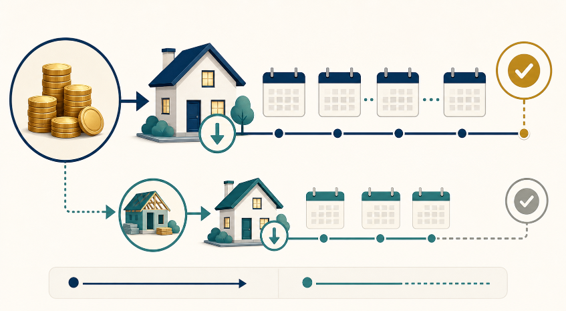
Here’s the calculation that actually matters: how many months of lower payments does it take to recoup what you paid upfront? This is illustrative math — your lender will run exact numbers based on your loan, but the process works the same way every time.
Say you’re financing $400,000 at today’s average 30-year fixed rate of around 6.5%.
Without points: - Rate: 6.5% - Monthly principal and interest: roughly $2,528
With 1 point ($4,000 paid at closing): - Rate: 6.25% - Monthly principal and interest: roughly $2,463 - Monthly savings: about $65
Breakeven calculation: $4,000 ÷ $65 per month ≈ 62 months, or about five years and two months.
That means if you plan to stay in the home — and keep this loan, without refinancing — for longer than roughly five years, paying that point saves you money over the life of the loan. If you’re planning to move, sell, or refinance sooner than that, you’d come out ahead by keeping the $4,000 and taking the higher rate.
Buying a second point roughly doubles both the cost and the monthly savings, so the breakeven timeline usually lands in a similar range. That’s not a guarantee — it depends on how your specific lender prices each point — but it’s a useful sanity check when you’re comparing offers.
A quick way to estimate your own breakeven:
1. Get your Loan Estimate with and without points from your lender.
2. Subtract the monthly payment with points from the payment without points.
3. Divide the cost of the points by that monthly savings figure.
4. Compare the result to how long you realistically expect to keep this loan.
When Paying Points Makes Sense (and When It Doesn’t)
The single biggest factor is your expected timeline in the home, not the rate itself.
Paying points tends to make sense when:
• You’re buying a long-term home and don’t expect to sell or refinance within the breakeven window.
• You have the cash available without stretching your reserves thin or reducing your down payment.
• You’re already comfortable with your other closing costs and this is truly extra cash, not money you need for repairs or moving expenses.
• Rates have been volatile and you want the certainty of a lower fixed payment for the long haul.
Paying points tends to not make sense when:
• You expect to sell within three to five years — for a relocation, a growing family needing more space, or a planned move.
• You’re already tight on cash to close and points would eat into your reserves or emergency fund.
• You expect rates to drop and plan to refinance in the next couple of years, which resets your breakeven clock before you’ve recouped the cost.
• You’d rather apply that cash toward a larger down payment, which reduces your loan amount and your mortgage insurance requirement in some cases.
There’s also a middle path worth asking your lender about: partial points. If a full point doesn’t quite pencil out for your timeline but you still want some rate relief, buying a half point can lower your payment with a shorter breakeven period.
Points vs. Builder-Paid Rate Buydowns — They’re Not the Same Thing
If you’ve been house hunting new construction in Mansfield, you may have also heard about builder-paid rate buydowns. It’s worth being clear on the difference, because these are two different financial tools.
Discount points, which we’ve covered here, are permanent — you pay them once at closing, and the lower rate applies for the entire life of the loan. You, the borrower, are the one paying for them.
Builder rate buydowns are usually temporary — often structured as a 2-1 or 1-0 buydown where the rate is reduced for the first one or two years and then steps back up to the note rate. These are typically funded by the builder, not you, as an incentive on new construction. We covered how those work in detail in our guide to builder rate buydowns in DFW — worth a read if you’re comparing new construction against resale.
Both tools lower your payment, but they solve different problems. Points are a long-term bet on staying put. A builder buydown is a short-term cushion while your income grows or expenses settle after a move.
Talk Numbers With Your Lender Before You Decide
Every scenario above is illustrative — your actual rate, point pricing, and breakeven will depend on your loan program, credit profile, and the lender you choose. The exact figures a lender quotes you today can shift with the market by the time you’re under contract, so treat these numbers as a framework for the conversation, not a substitute for your own Loan Estimate.
We’re not lenders, but we work alongside several in the Mansfield and greater DFW area every week, and part of our job is making sure you’re asking the right questions before you sit down with one. If you’re budgeting for a purchase, it’s also worth understanding what else shows up at the table — our breakdown of cash to close walks through how points, down payment, and other closing costs add up together.
If you’re weighing whether points make sense for your specific purchase, reach out to our team. We’ll walk through your timeline, connect you with a lender who can run the real numbers on a specific property, and help you decide with actual math instead of guesswork.
Frequently Asked Questions
How much does one mortgage point typically cost?
One point costs 1% of your total loan amount. On a $350,000 loan, that’s $3,500; on a $500,000 loan, it’s $5,000. This is paid upfront at closing, separate from your down payment.
How much will one point lower my interest rate?
Most lenders reduce your rate by about 0.25% per full point, though the exact amount varies by lender, loan program, and market conditions on the day you lock your rate. Always ask your loan officer for the specific reduction tied to your quote.
What’s a good breakeven period for buying points?
There’s no universal rule, but most buyers who benefit from points recoup their cost within four to eight years. If your breakeven lands well beyond how long you expect to keep the loan, points typically aren’t worth it.
Can I negotiate who pays for points — buyer or seller?
Yes. In some purchase contracts, sellers agree to credit part of the buyer’s closing costs, which can be applied toward points. This is a negotiation point in your offer, and it’s something we discuss with every buyer client before writing a contract.
Are mortgage points tax deductible?
Points may be deductible in certain circumstances, but the rules depend on your individual tax situation and whether the points meet IRS requirements. Confirm your specific situation with a qualified tax professional before assuming a deduction applies.
Is paying points the same as a builder rate buydown?
No. Discount points are a permanent rate reduction you pay for at closing, lasting the life of the loan. A builder rate buydown is typically temporary and funded by the builder, usually stepping the rate up after one or two years.
If you’re thinking through this for your own purchase in Mansfield, we’re happy to walk you through the numbers alongside a trusted local lender. Reach out anytime — we’d rather you make this decision with real math than a guess.
About The Chad Smith Team
The Chad Smith Team at Realty of America is one of the top-producing real estate teams in the Dallas-Fort Worth Metroplex, with more than 22 years of experience, 2,915 homes sold, and recognition by RealTrends among the top 1% of real estate professionals nationwide. The team helps first-time buyers, sellers, relocation clients, and new construction buyers throughout Arlington, Mansfield, Fort Worth, Midlothian, Waxahachie, and surrounding DFW communities. Through this blog, the Chad Smith Team shares expert market insights and practical advice to help North Texas buyers and sellers make informed real estate decisions.