Living in Weatherford: The Historic Square and Parker County Roots
What is it like living in Weatherford, Texas?
Living in Weatherford means splitting your time between a walkable 1880s courthouse square lined with shops and restaurants and wide-open Parker County land where horses and cattle are still part of daily life. The town is known as the “Cutting Horse Capital of the World,” home to the National Cutting Horse Association’s headquarters since 1969, and it offers a real mix of housing — from historic homes a few blocks from the square to 1- to 10-plus-acre properties on the edges of town. Fort Worth sits about 25 to 30 minutes east on I-20, so residents get small-town character with a straightforward commute into the Metroplex.
By The Chad Smith Team | November 6, 2026
Weatherford doesn’t feel like a suburb that got absorbed into the DFW Metroplex. It feels like a county seat that’s held onto its own identity — a limestone courthouse anchoring a downtown square, a horse show or livestock event happening most weekends, and enough open land on the edges of town that you can still smell hay and cattle from your back porch. If you’re weighing a move west of Fort Worth, here’s a look at what actually makes up daily life in Weatherford.
The Historic Downtown Square
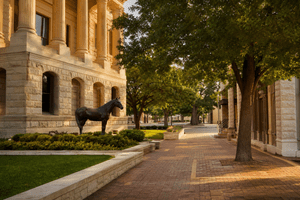
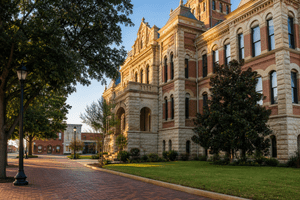
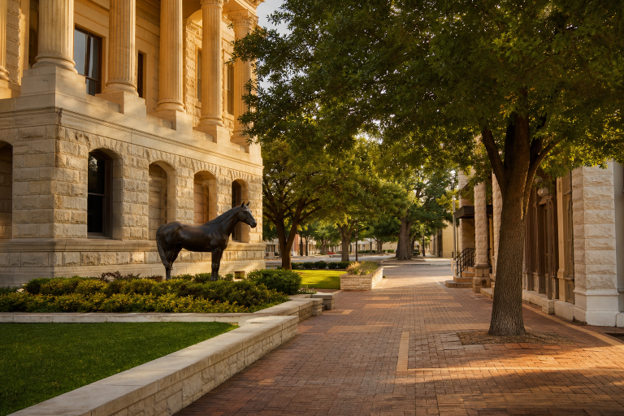
The center of Weatherford is, quite literally, the Parker County Courthouse. Built between 1884 and 1886, the three-story limestone Second Empire building was designed by architect Wesley Clark Dodson, who designed several Texas courthouses during that era. It’s listed on the National Register of Historic Places, both as an individual landmark and as the anchor of the larger Weatherford Downtown Historic District, and it’s also designated a Texas State Antiquities Landmark.
Around the courthouse, the square is built out with locally owned shops, restaurants, and storefronts housed in buildings that have been standing for well over a century. It’s the kind of downtown where you can grab coffee, browse antiques, eat lunch, and run into three people you know — all within a couple of blocks. The square regularly hosts community events, seasonal markets, and festivals that draw people in from across Parker County, not just from inside the city limits.
For buyers, homes within walking distance of the square tend to be older — turn-of-the-century cottages and bungalows on smaller in-town lots, many of which have been updated over the years while keeping their original character. If a walkable downtown and a shorter commute to daily errands matters to you, this is the part of Weatherford to focus your search on.
Ranching and Equestrian Roots Run Deep
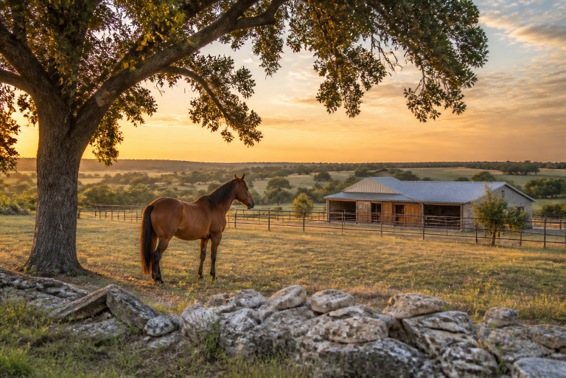
Weatherford’s nickname, the “Cutting Horse Capital of the World,” isn’t a marketing slogan — it’s a title the town has earned. Cutting is a competitive event where a horse and rider work together to separate a single cow from a herd, and Weatherford has been at the center of that sport since cattle ranching built the local economy in the early 1900s. The area became a hub for cutting horse breeders and trainers by the 1940s, and in 1969 the National Cutting Horse Association relocated its headquarters here, cementing the town’s reputation nationally.
That heritage shows up everywhere, not just in competition arenas. Feed stores, tack shops, and equine veterinary clinics are part of the everyday business landscape. Horse trailers are a normal sight on the roads. Many properties on the outskirts of town are set up with barns, cross-fencing, and arenas built for working horses and cattle rather than just backyard space. Even in town, you’ll find a bronze cutting horse statue outside the Weatherford Chamber of Commerce — a nod to how central the industry is to local identity.
If you or your family are already involved in the horse or cattle world, Weatherford puts you close to trainers, veterinarians, and facilities that a lot of other DFW-area towns simply don’t have.
In-Town Homes vs. Acreage on the Edge of the City
One of the more distinctive things about Weatherford’s housing stock is how much range it covers within a single market. Close to the square, you’ll find historic homes and newer infill construction on standard in-town lots — walkable, close to shopping and dining, and generally on the smaller end of the lot-size spectrum.
Move a few miles out in any direction, and the picture changes. Weatherford has an extensive inventory of larger properties — often 1 to 10-plus acres — built for horses, livestock, workshops, and general elbow room. It’s a market shaped by both suburban-style developments and traditional acreage tracts, which is part of what makes it feel different from more uniformly suburban DFW communities.
As of mid-2026, homes listed in Weatherford carried a median asking price in the mid-$500,000s, with recent sold prices trending somewhat lower — a reminder that list price and sold price aren’t the same thing in this market, and that acreage, lot improvements, and proximity to downtown all move the number. Whether an in-town cottage or a country property with a barn makes more sense for you comes down to how you want to live day to day, not just budget.
If you’ve read our post on understanding DFW Metroplex growth and what it means for homeowners, you already know how much the region’s expansion is reshaping demand in towns like Weatherford that sit just outside the core suburbs. That growth is part of why both the in-town and acreage segments of this market have stayed active.
Getting Around: I-20 and the Commute Into Fort Worth
Weatherford sits roughly 25 to 30 miles west of downtown Fort Worth, connected primarily by Interstate 20. Under normal conditions, that’s about a 30- to 35-minute drive, with the trip stretching closer to 45 minutes to an hour during heavier rush-hour traffic, particularly near the I-820 and I-30 interchanges on the Fort Worth side.
Inside Weatherford itself, most day-to-day driving is short — the town is compact enough that errands, the square, and local services are a quick trip from most neighborhoods. For residents who work in Fort Worth or need occasional access to the wider Metroplex, I-20 is the primary artery, and it’s the route most people planning a move here will want to test-drive at different times of day before deciding where to buy.
The trade-off is a familiar one for anyone considering a move to the outer edge of DFW: more land and a slower pace close to home, balanced against a commute that requires planning if your job is closer to the urban core.
Frequently Asked Questions
What makes Weatherford’s downtown square historic?
The square is anchored by the Parker County Courthouse, a three-story limestone building constructed between 1884 and 1886. It’s listed on the National Register of Historic Places as part of the Weatherford Downtown Historic District and is also a designated Texas State Antiquities Landmark.
Why is Weatherford called the Cutting Horse Capital of the World?
Weatherford’s ranching economy in the early 1900s gave rise to a strong cutting horse tradition, and the town became a hub for breeders and trainers by the 1940s. The National Cutting Horse Association moved its headquarters to Weatherford in 1969, which helped cement the nickname.
Can I find both in-town homes and acreage properties in Weatherford?
Yes. Weatherford’s housing market includes historic and newer homes on standard lots close to the square, along with an extensive inventory of larger properties — often 1 to 10-plus acres — set up for horses, livestock, and workshops on the outskirts of town.
How far is Weatherford from Fort Worth?
Weatherford is about 25 to 30 miles west of Fort Worth via Interstate 20. The drive typically takes 30 to 35 minutes in light traffic and can stretch to 45 minutes or more during rush hour near the I-820 and I-30 interchanges.
Is Weatherford part of the Dallas-Fort Worth Metroplex?
Weatherford is the seat of Parker County and sits on the western edge of the DFW Metroplex. It maintains its own distinct downtown and rural character while still being within commuting range of Fort Worth via I-20.
Thinking About a Move to Weatherford?
Weatherford offers something you don’t find everywhere in the Metroplex — a genuine historic downtown built around a working courthouse square, paired with real ranch and equestrian country just outside city limits. Whether you’re drawn to a walkable in-town setting or a property with room for horses, the options here are broad, and the right fit depends on the kind of daily life you’re after.
If you’re exploring what it would look like to live in Weatherford or anywhere else in Parker County, we’re happy to walk you through the neighborhoods, the acreage market, and the commute realities firsthand. Reach out anytime.
About The Chad Smith Team
The Chad Smith Team at Realty of America is one of the top-producing real estate teams in the Dallas-Fort Worth Metroplex, with more than 22 years of experience, 2,915 homes sold, and recognition by RealTrends among the top 1% of real estate professionals nationwide. The team helps first-time buyers, sellers, relocation clients, and new construction buyers throughout Arlington, Mansfield, Fort Worth, Midlothian, Waxahachie, and surrounding DFW communities. Through this blog, the Chad Smith Team shares expert market insights and practical advice to help North Texas buyers and sellers make informed real estate decisions.