Exploring Waxahachie’s Historic Square and Home Districts
What’s It Like to Live Near Waxahachie’s Historic Square?
Living near Waxahachie’s downtown square means being minutes from the Romanesque Revival Ellis County Courthouse, a walkable grid of Victorian- and Craftsman-era homes, and a downtown built around locally owned shops, restaurants, and events. The surrounding historic districts — including West End and North Rogers Street — feature homes mostly built between the 1880s and 1920s, while newer master-planned neighborhoods have grown up along I-35E and US 287 on the edges of town. Both offer easy access into Dallas and Fort Worth, but they deliver very different day-to-day experiences.
By The Chad Smith Team | November 6, 2026
Waxahachie’s downtown square is one of the more recognizable spots in Ellis County, and it’s easy to see why once you’ve stood in front of the courthouse. Whether you’re weighing a move into one of the historic districts that ring the square or you’re simply curious what “living downtown” actually looks like here, it helps to know what’s really there — the architecture, the districts, and the practical side of daily life a few blocks from Main Street.
The square has also picked up a reputation beyond Ellis County. Its intact turn-of-the-century storefronts and courthouse backdrop have made it a recurring filming location for movies and television productions over the years, and it’s a regular stop for people touring historic North Texas towns. For the people who actually live in the blocks around it, though, the square is less a backdrop and more the everyday center of town — the place you’d walk to for coffee, a library card, or a Saturday errand.
The Square Itself: Courthouse, Architecture, and Daily Life
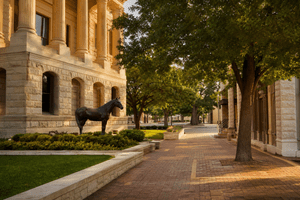
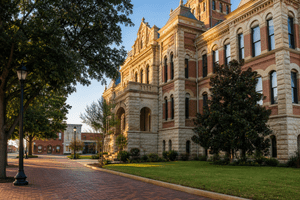
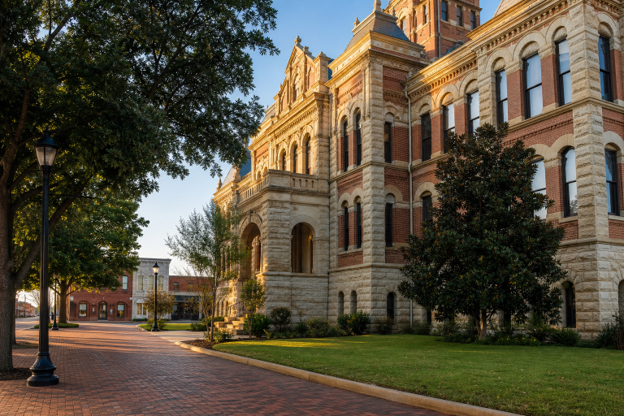
The centerpiece of downtown Waxahachie is the Ellis County Courthouse, built in 1897 in the Romanesque Revival style. Its red granite and sandstone exterior, ornate stone carvings, and tall clock tower have made it one of the most photographed courthouses in Texas — locals will tell you it’s second only to the Alamo in that regard. The building went through a roughly $12 million restoration completed in 2002, which is part of why it still looks the way it does in old postcards.
Ring the courthouse and you’ll find blocks of late-19th and early-20th century commercial buildings, many with the ornate wood and stone trim that earned Waxahachie its longtime nickname, “Gingerbread City.” That same detailing shows up on the homes just outside the commercial core, which is part of what makes the walk from the square into the surrounding neighborhoods feel continuous rather than like crossing into a different town.
Day to day, the square functions as Waxahachie’s downtown in the fullest sense — not a tourist backdrop that empties out at 5 p.m. You’ll find:
• Locally owned restaurants, coffee shops, and tea rooms
• Antique stores, boutiques, and specialty shops
• The Ellis County Museum and the Ellis County Art Museum
• Sims Library, a short walk from the courthouse steps
• Live music and community gatherings on the square through the year
The square also hosts the Gingerbread Trail Tour of Homes, a self-guided tour that’s run for more than 55 years and typically takes place the first weekend in June. It opens the doors of several historic homes in the districts around downtown, alongside stops at courthouse-area landmarks — a good way to see the interiors of these homes before ever touring one with an agent.
For anyone comparing Waxahachie’s downtown to other historic cores around the Metroplex, the pattern will look familiar. Mansfield’s historic downtown district follows a similar model — older homes built around a compact, walkable commercial center — just on a smaller footprint than Waxahachie’s square and surrounding blocks.
Home Styles Across Waxahachie’s Historic Districts
Waxahachie has five districts listed on the National Register of Historic Places: West End, North Rogers Street, Oldham Avenue, Wyatt Street Shotgun House, and the Ellis County Courthouse Historic District itself. Two of these areas — the downtown core and Oldham Avenue — also sit within local Historic Overlay Districts, which is a separate, city-level designation from the National Register listing.
Most of the housing stock in these districts dates to the cotton boom era of the late 1800s and early 1900s, when Ellis County was among the largest cotton-producing counties in the country and the resulting wealth fueled a wave of home construction that’s still visible today. The styles you’ll come across walking these blocks include:
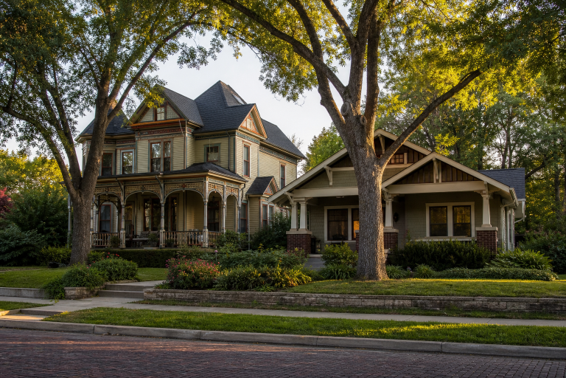
• Queen Anne and Folk Victorian — turned porch posts, decorative gable trim, asymmetrical rooflines, and wraparound porches
• Classical Revival — symmetrical facades and columned porches
• Craftsman/Bungalow — lower-slung rooflines, exposed rafter tails, and front porches with tapered columns, typically dating to the 1920s
The West End Historic District runs roughly seven blocks along W. Main Street and four blocks along W. Jefferson Street, and it’s known for a strong concentration of Queen Anne and Classical Revival homes. North Rogers Street carries a similar mix of Folk Victorian, Queen Anne, and Classical Revival styles a few blocks over, with its own distinct streetscape.
Because so many of these homes are 90 to 130-plus years old, living in one of these districts comes with a different set of considerations than living in new construction. Original materials — heart pine floors, plaster walls, older wiring and plumbing — are common, and the extent of past updates varies a lot from house to house. That range is part of what makes walking these blocks interesting: a fully restored Queen Anne might sit two doors down from a home that still has decades of original character waiting to be uncovered.
Exterior work on a home inside one of the local Historic Overlay Districts — downtown or Oldham Avenue — may also go through a design review process with the city’s Downtown and Historic Preservation Manager, since those overlays exist specifically to keep street-facing changes in line with the district’s historic character. That review generally applies to visible exterior changes rather than interior work, but it’s worth confirming early if you’re picturing anything structural or exterior-facing down the road.
Old Square vs. New Growth — and the Commute Into Dallas-Fort Worth
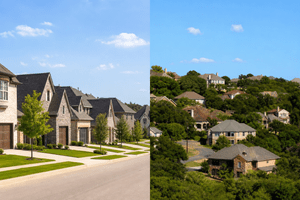
Waxahachie isn’t frozen in the 1900s. Outside the historic core, the town has seen substantial new construction over the past several years, with master-planned communities like Myrtle Creek offering new homes roughly in the $300s to $800s, plus additional large-scale developments approved or underway on the edges of town. That growth is part of a broader pattern across the DFW Metroplex, where outward expansion along major highway corridors has reshaped a lot of formerly rural land into new subdivisions.
The practical difference between the two areas comes down to lot size, home age, and walkability more than anything else. Near the square, lots tend to be smaller and closer together, homes are older with more architectural character, and you can walk to dinner, the library, or the museum. Out on the newer side of town, you’ll typically find larger, more uniform lots, amenity centers, trails, and homes built to current code — but a short drive rather than a walk to reach downtown.
Neither approach is right or wrong — it comes down to what kind of daily routine you’re picturing. Some buyers want the front porch and the two-minute walk to a coffee shop that a historic district offers. Others want a larger lot, a newer floor plan, and neighborhood amenities, with downtown as a weekend destination rather than a backyard. Waxahachie is one of the few places in Ellis County where both of those options exist within the same city limits.
Both areas share the same commute picture, since Waxahachie sits at the junction of I-35E, US 287, and US 77. Downtown Dallas is roughly 30 miles and about 35 minutes north via I-35E under normal traffic conditions. Fort Worth runs closer to 45 minutes west via US 287. That access is one of the reasons Waxahachie has drawn steady interest from people working in either city while wanting more space — or more architectural character — than they’d typically find closer in to the urban core.
Frequently Asked Questions
How old are the historic homes near Waxahachie’s downtown square?
Most homes in the districts around the square were built between the 1880s and 1920s, during Ellis County’s cotton boom era. You’ll see Queen Anne, Folk Victorian, Classical Revival, and Craftsman/Bungalow styles, often with original materials like heart pine flooring and plaster walls still intact.
Are there special rules for renovating a historic home in Waxahachie?
Homes within the city’s Downtown Historic Overlay or Oldham Avenue Historic Overlay may need design review for visible exterior changes, through the city’s Downtown and Historic Preservation Manager. This is generally separate from a home’s listing on the National Register of Historic Places, which by itself doesn’t require city approval for changes.
What’s the difference between Waxahachie’s historic districts and its newer neighborhoods?
The historic districts around the square have smaller lots, older homes with more architectural detail, and walkable access to downtown shops and restaurants. Newer master-planned communities on the edges of town offer larger lots, current building codes, and amenity centers, with a short drive rather than a walk into the historic core.
How far is Waxahachie’s square from Dallas and Fort Worth?
Downtown Dallas is about 30 miles and roughly 35 minutes north of Waxahachie via I-35E. Fort Worth is about 45 minutes west via US 287, which meets I-35E and US 77 right in Waxahachie.
What happens on Waxahachie’s square throughout the year?
The square hosts regular live music, local shopping and dining, and the annual Gingerbread Trail Tour of Homes, typically held the first weekend in June, which opens several historic homes and downtown landmarks to visitors.
If you’re curious what’s currently available near the square or out in one of Waxahachie’s newer neighborhoods, we’re happy to send over some options or answer questions about the area. Reach out anytime.
About The Chad Smith Team
The Chad Smith Team at Realty of America is one of the top-producing real estate teams in the Dallas-Fort Worth Metroplex, with more than 22 years of experience, 2,915 homes sold, and recognition by RealTrends among the top 1% of real estate professionals nationwide. The team helps first-time buyers, sellers, relocation clients, and new construction buyers throughout Arlington, Mansfield, Fort Worth, Midlothian, Waxahachie, and surrounding DFW communities. Through this blog, the Chad Smith Team shares expert market insights and practical advice to help North Texas buyers and sellers make informed real estate decisions.