Selling a House During Divorce in Mansfield: What to Expect
What happens when you sell a house during a divorce in Mansfield, TX?
When you sell a house during a divorce, the title company treats both spouses as sellers regardless of whose name is on the mortgage, so both must sign the listing paperwork, the deed, and the closing disclosure. The title company pays off the mortgage and closing costs first, then holds or disburses the remaining proceeds according to your divorce decree, a signed settlement agreement, or a court order. If one spouse won’t cooperate, the other’s family law attorney can ask the court to compel the sale or appoint a receiver to sign on their behalf.
By The Chad Smith Team | August 6, 2026

Selling a home while a divorce is in progress is a different process than a standard sale, mostly because of who has to sign what, and when. If you’re staring down a listing appointment and a family law case at the same time, here’s what actually happens at each step — from title to closing.
Both names on title means both signatures at every stage
Texas is a community property state. If the home was purchased during the marriage — or if both spouses are on the deed regardless of when it was purchased — the title company will require both signatures throughout the transaction, not just at closing.
That includes:
• The listing agreement. Most brokerages want both owners to sign before the home goes on the market, since both have an ownership interest.
• Offer acceptance. Both spouses need to agree to (or at least sign off on) the accepted offer.
• The deed. Only a signed, notarized deed from every owner on title conveys clear ownership to the buyer.
• The closing disclosure and settlement statement. The title company won’t release funds without every seller’s signature here.
If your name isn’t on the mortgage but is on the deed, you still have to sign. And if your name is on the mortgage but not the deed, you’re still on the hook for the loan even after the sale — the payoff at closing is what actually releases that lien, not the divorce decree.
If one spouse lives out of state or simply can’t attend the closing in person, a properly executed power of attorney can stand in — but it needs to be prepared and reviewed well before closing day. Title companies in Tarrant County will not accept a POA that shows up as a last-minute workaround; it has to name the specific transaction and be notarized in advance.
How the title company splits the proceeds
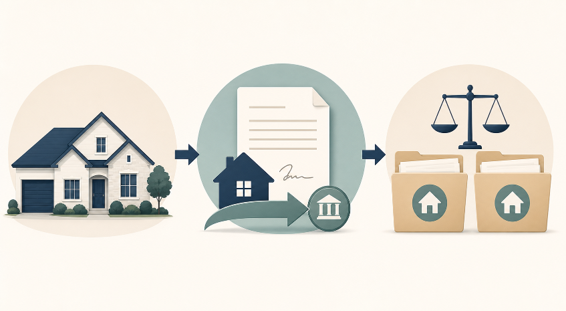
The title company (also called the escrow or closing agent here in Texas) is a neutral party. It doesn’t decide how proceeds get divided — it follows instructions. Those instructions come from one of three places:
1. A signed marital settlement agreement or mediated agreement, if you and your spouse have worked out the split outside of court.
2. A temporary order or final divorce decree, if a judge has already ruled on the division.
3. A joint written instruction letter, signed by both spouses, if the sale is happening informally before a decree exists.
At closing, the math runs in this order: sale price, minus the existing mortgage payoff, minus closing costs (title fees, prorated property taxes, any agreed repairs or credits, and real estate commissions), equals net proceeds. From there, the title company either:
• Disburses each spouse’s share directly according to the agreed percentage (commonly 50/50, but not always), or
• Wires the full net proceeds into a joint escrow account, an attorney trust account, or the registry of the court, to be divided later once the divorce is finalized.
That second option is common when the split itself is still being negotiated — the house sale doesn’t have to wait on every detail of the divorce to be resolved, but the money often does.
Mortgage payoff comes before anyone sees a dollar
Whatever is owed on the mortgage gets paid off automatically at closing, straight out of the sale proceeds, before either spouse receives their share. This happens whether one or both spouses are on the loan. If the loan balance is close to the expected sale price, run the numbers early — you don’t want to find out at the closing table that there’s little or nothing left to split.
It’s also worth confirming who has been making payments during the separation. If one spouse has been covering the mortgage, taxes, or insurance solo, that’s frequently addressed as a reimbursement claim in the divorce case, separate from the closing itself. The title company won’t sort that out — your attorneys will, either in the decree or the settlement agreement.
Timing: do you need court approval to sell?
It depends on where you are in the process.
• No case filed yet, or an informal agreement: If both spouses agree to sell before anything is filed, you generally don’t need court approval — you just both need to sign, the same as any other sale with co-owners.
• Case filed, no temporary orders yet: Many Tarrant County family courts issue standing orders early in a divorce case that restrict selling, transferring, or encumbering marital property without written agreement or court permission. Check what’s been filed in your case before you sign a listing agreement.
• Temporary orders in place: These often specifically address the house — sometimes authorizing an immediate sale, sometimes requiring one spouse to stay in the home until the case resolves.
• Final decree already signed: If the decree orders the house sold, both parties are expected to cooperate on the timeline it specifies. Selling under a final decree is usually the most straightforward version of this process, since the terms are already spelled out.
Most divorce attorneys recommend listing sooner rather than later if a sale is inevitable — homes sitting vacant or in limbo during a long case tend to cost both spouses money in carrying costs, deferred maintenance, and market timing.
If one spouse won’t cooperate
This is the scenario that stalls sales the longest, and it’s genuinely a legal issue, not a real estate one — but here’s what typically happens:
• If there’s a decree or court order requiring the sale, refusal to sign or cooperate can be treated as contempt of court, and the other spouse’s attorney can file to enforce it.
• The court can appoint a receiver — a neutral third party with authority to list, market, negotiate, and sign closing documents on behalf of an uncooperative spouse.
• In some cases, the court appoints an attorney-in-fact to sign specifically for the sale.
• There’s roughly a two-year window to file an enforcement action after a decree is signed, so this isn’t something that can sit indefinitely.
None of this is something a real estate agent or title company can resolve — it goes through your family law attorney and the court. What an experienced agent can do is keep the transaction itself moving cleanly once cooperation (voluntary or court-ordered) is in place, and document everything so there’s no ambiguity for the title company.
Disclosure obligations don’t disappear because of the divorce
If you’re transferring the home directly to your spouse as part of the divorce settlement, Texas law exempts that specific transfer from the Seller’s Disclosure Notice requirement. But that exemption applies only to transfers between the two spouses — it does not apply when you sell to an outside buyer.
If you’re listing the home for sale to a third-party buyer, standard Texas disclosure rules apply in full. Whichever spouse has knowledge of the property’s condition is expected to disclose it, and both spouses signing the listing are generally expected to complete the disclosure form together, or at minimum, not contradict each other on it. For a full breakdown of what has to be disclosed and how the form works, see our guide on the Texas Seller’s Disclosure Notice and what Mansfield sellers must know.
Getting the disclosure right matters even more in a divorce sale, since a dispute between spouses about what was known and when can complicate an already difficult transaction.
What this looks like in practice
Every divorce case is different, and the property piece is only one part of a larger legal process. Your specific timeline, proceeds split, and signature requirements depend on where your case stands and what your decree or agreement says — that’s a conversation for your family law attorney.
What we can help with is the real estate side: pricing the home accurately, coordinating showings and offers around two schedules instead of one, working directly with both spouses’ attorneys when needed, and making sure the title company has clean instructions so proceeds move without delay or disputes. We’ve walked several Mansfield-area sellers through exactly this process, and the transactions that go smoothly are almost always the ones where the real estate side and the legal side are talking to each other from day one.
If you want a broader look at how these sales typically unfold, we also put together our overview of selling during a divorce in Mansfield, which covers the bigger-picture decisions alongside this step-by-step version.
Frequently Asked Questions
Do both spouses have to be present at closing if we’re getting divorced?
Not necessarily in person, but both need to sign the deed and closing disclosure. If one spouse can’t attend, a power of attorney prepared and notarized in advance can allow someone else to sign on their behalf — but this needs to be set up well before closing day, not the morning of.
Who gets the proceeds from the house sale during a divorce?
The title company disburses proceeds according to a signed settlement agreement, a court order, or joint written instructions from both spouses. Without one of those, most title companies will hold the funds in escrow rather than guess at a split.
Can I sell the house before the divorce is final in Texas?
Yes, if both spouses agree, or if a temporary order authorizes it. Selling before the decree is finalized is common and often recommended to avoid carrying costs on a home neither spouse wants to keep.
What if my spouse refuses to sign the listing agreement or closing documents?
If a court order already requires the sale, your attorney can file to enforce it, which can lead to contempt proceedings or the court appointing a receiver to sign on your spouse’s behalf. This process runs through your family law attorney and the court, not through the title company or your real estate agent.
Do we still need a Seller’s Disclosure Notice if we’re selling because of a divorce?
Yes, if you’re selling to a third-party buyer. The disclosure exemption only applies to transfers directly between spouses as part of the divorce, not to sales on the open market.
How long does it typically take to sell a house during a divorce in Mansfield?
A typical Mansfield-area sale runs roughly two to three months from listing to closing under normal market conditions, similar to a standard sale. The variable that adds time in a divorce is usually coordinating signatures, agreements, or court approval — not the market itself.
If you’re navigating a sale like this right now, we’re glad to talk through what your situation specifically requires. Reach out to the Chad Smith Team, and we’ll help you get the real estate side handled clearly and quickly, while you focus on the rest.
For additional help with the real estate side of a separation or divorce, review the Chad Smith Team’s DFW divorce and life-transition real estate guide.
About The Chad Smith Team
The Chad Smith Team at Realty of America is one of the top-producing real estate teams in the Dallas-Fort Worth Metroplex, with more than 22 years of experience, 2,915 homes sold, and recognition by RealTrends among the top 1% of real estate professionals nationwide. The team helps first-time buyers, sellers, relocation clients, and new construction buyers throughout Arlington, Mansfield, Fort Worth, Midlothian, Waxahachie, and surrounding DFW communities. Through this blog, the Chad Smith Team shares expert market insights and practical advice to help North Texas buyers and sellers make informed real estate decisions.