Manufactured Homes vs. Site-Built in Tarrant County
Manufactured home vs. site-built home in Tarrant County: which is the better buy?
The right choice comes down to land and foundation. A manufactured home on a permanent foundation and land you own qualifies for a normal mortgage, builds equity, and appreciates at nearly the same pace as a site-built home — while costing far less up front (a new manufactured home averages around $125,000 versus roughly $425,000 for a new site-built home). A manufactured home on leased land, financed with a chattel loan, builds no land equity and can be harder to resell. Site-built homes cost more but offer the widest financing options, the strongest resale demand, and the most flexibility in Tarrant County’s market.
By The Chad Smith Team | August 21, 2026
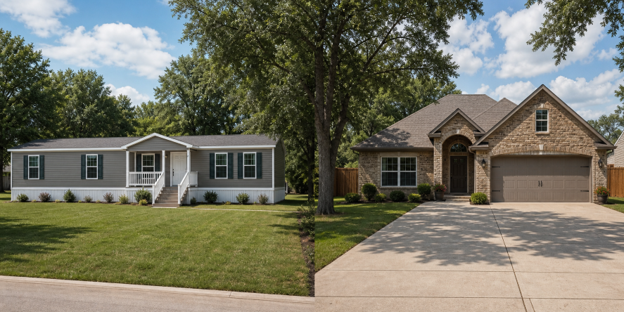
If you’re trying to get into a home around Mansfield without a site-built price tag, a manufactured home probably crossed your mind. The sticker difference is hard to ignore. But “cheaper” and “better investment” aren’t the same thing, and the gap between the two depends almost entirely on a couple of details most first-time buyers don’t think about: what the home sits on, and who owns the ground underneath it.
Here’s an honest comparison to help you decide which path fits your situation.
First, get the terms straight
Manufactured homes are built entirely in a factory to a federal HUD building code, then transported to the site. Since 1976, they’ve been regulated under that HUD standard — which is different from the older “mobile home” label you’ll still hear people use.
Site-built homes (sometimes called “stick-built”) are constructed on the lot from the ground up, under local and state building codes and Tarrant County permitting.
There’s also a middle category worth knowing: modular homes, which are built in sections in a factory but assembled on a permanent foundation and inspected to the same local codes as site-built homes. Modular tends to behave more like site-built when it comes to financing and resale.
The cost gap is real — but so is the catch
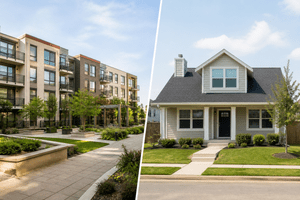
The up-front difference is dramatic. Nationally in 2026, a new manufactured home averages roughly $125,000, while a new site-built home averages about $425,000. That’s close to a $300,000 spread.
But the price you see rarely tells the whole story. With a manufactured home, you still have to account for:
• The land, if you don’t already own it
• Site preparation, utility hookups, and a foundation
• Delivery and installation
• Any required skirting, decks, or steps
Once a manufactured home is set on owned land with a permanent foundation, the total gap narrows — but it usually stays meaningfully cheaper than comparable site-built construction. That affordability is the whole appeal.
Financing is where the two really diverge
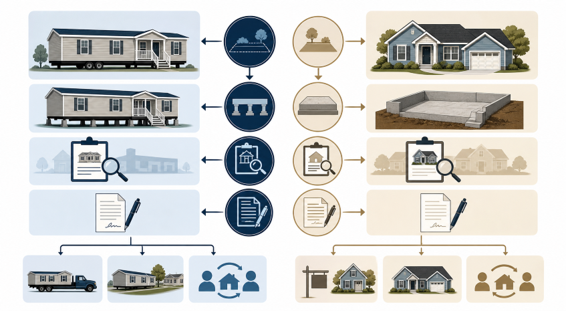
This is the single most important part of the decision, so it’s worth slowing down.
If a manufactured home is on a permanent foundation and you own the land, it’s typically treated as real property. That means you can finance it with a conventional, FHA, VA, or USDA mortgage — the same tools a site-built buyer uses, often with competitive rates.
If the home is on a non-permanent foundation or on leased land (like a lot in a manufactured-home community), it’s usually classified as personal property, and you’ll be looking at a chattel loan. Chattel loans tend to carry higher interest rates and shorter terms than a traditional mortgage.
Site-built homes don’t have this fork in the road. They’re real property by default, which is why they have the broadest, most competitive financing menu. If you’re weighing loan types generally, our breakdown of FHA versus conventional loans for first-time buyers is a useful companion to this decision.
Appreciation and resale: the surprising part
There’s an old assumption that manufactured homes always lose value. The data tells a more nuanced story. Research from the Urban Institute found manufactured homes appreciated about 211.8% between 2000 and 2024 — nearly identical to the 212.6% for site-built homes over the same stretch — and in many recent years they’ve actually appreciated faster.
But — and this is the key — that appreciation shows up when the home is on land the owner controls. A manufactured home on owned land, financed as real property, behaves like most residential real estate: it builds equity and appreciates. A manufactured home on leased land carries more risk. You build no equity in the ground, you’re exposed to lot-rent increases and community rules, and resale can be slower and more likely to need a price adjustment.
Site-built homes still draw the deepest buyer pool in Tarrant County, which generally means faster sales and more predictable resale — an advantage that matters if you might move again in a few years.
So which one is right for you?
A manufactured home on owned land can be a smart move if:
• You want to keep your monthly payment and total cost down
• You already own or plan to buy the lot, and can put the home on a permanent foundation
• You’re planning to stay put long enough to benefit from equity building
• You qualify for real-property financing
A site-built home usually makes more sense if:
• Resale flexibility and speed matter to you
• You want the widest range of financing and the most competitive rates
• You value long-term buyer demand and easier appraisals
• The higher price fits your budget and timeline
The worst-case scenario to avoid is a manufactured home on leased land bought with a chattel loan when you actually need an appreciating asset — that combination gives up most of the benefits people are hoping for.
Every situation is different, and the only way to know which path pencils out is to compare real numbers against your goals and how long you plan to stay. That’s a conversation we have with Tarrant County buyers all the time, and we’re glad to walk you through it.
Frequently Asked Questions
Can you get a regular mortgage on a manufactured home in Texas?
Yes, if the home is on a permanent foundation and you own the land, it can usually be financed as real property with a conventional, FHA, VA, or USDA loan. If it’s on leased land or a non-permanent foundation, you’ll typically need a chattel loan instead, which carries higher rates and shorter terms.
Do manufactured homes appreciate in value?
They can, and often at nearly the same pace as site-built homes — but mainly when they sit on land the owner controls. On leased land, you build no equity in the ground, and resale tends to be slower and more price-sensitive.
Is a manufactured home cheaper than a site-built home in Tarrant County?
Almost always up front. A new manufactured home averages around $125,000 nationally versus about $425,000 for site-built. Once you add land, foundation, and site work, the gap narrows but typically remains significant.
What’s the difference between a manufactured home and a modular home?
A manufactured home is built to a federal HUD code and delivered largely complete. A modular home is built in sections in a factory but assembled on a permanent foundation and inspected to the same local codes as site-built homes, so it usually finances and resells more like a site-built home.
The bottom line
Manufactured homes have come a long way, and on owned land with real-property financing they can be a genuinely smart, affordable path to ownership near Mansfield. Site-built homes cost more but bring the strongest financing options and the deepest resale demand. The deciding factor isn’t the building method — it’s the land, the foundation, and how long you plan to stay.
If you’re weighing the two for your own budget and timeline, we’re happy to help you compare the real numbers side by side. Reach out anytime.
About The Chad Smith Team
The Chad Smith Team at Realty of America is one of the top-producing real estate teams in the Dallas-Fort Worth Metroplex, with more than 22 years of experience, 2,915 homes sold, and recognition by RealTrends among the top 1% of real estate professionals nationwide. The team helps first-time buyers, sellers, relocation clients, and new construction buyers throughout Arlington, Mansfield, Fort Worth, Midlothian, Waxahachie, and surrounding DFW communities. Through this blog, the Chad Smith Team shares expert market insights and practical advice to help North Texas buyers and sellers make informed real estate decisions.