Lakefront vs. Lake-Access Homes in Granbury: What’s the Difference?
What’s the difference between lakefront and lake-access homes in Granbury?
A lakefront home in Granbury sits directly on Lake Granbury’s shoreline, giving the owner private water frontage and the ability to apply for a private boat dock through the Brazos River Authority. A lake-access home sits in a neighborhood near the lake but doesn’t touch the water itself — instead, the property comes with rights to a shared boat ramp, community dock, or marina slip, usually through an HOA. The gap between the two shows up in price, in flood insurance requirements, in ongoing dues, and in how much control you have over your own water access.
By The Chad Smith Team | November 13, 2026
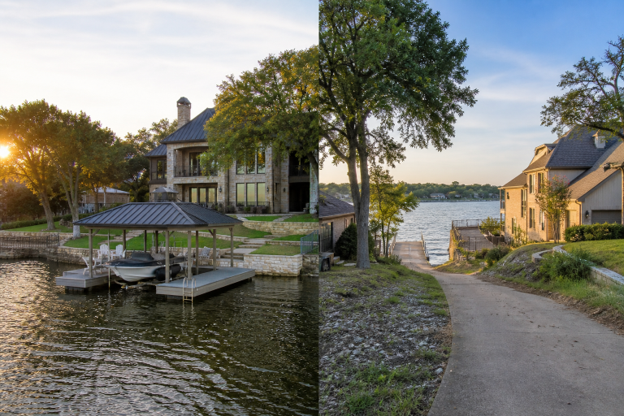
You’re comparing two very different ownership experiences, not two versions of the same thing.
A lakefront listing on Lake Granbury and a lake-access listing three streets back can look similar in square footage and finish level. But one comes with a private shoreline, a shot at your own dock, and a flood insurance conversation. The other comes with a shared ramp, an HOA dues statement, and a lower purchase price. Neither is the “better” choice — they’re built for different priorities, and knowing which one fits your budget and your lifestyle before you start touring homes saves you from falling for a listing that isn’t actually what you want.
Lakefront vs. Lake-Access: What You’re Actually Buying
Lakefront means the property line runs to the water. You own the shoreline, you control who sets foot on it, and you can pursue a private dock permit for your own boat, jet skis, or a swim platform. Some lakefront lots have a full backyard’s width touching the lake; others have a narrower wedge of frontage. Both count as lakefront, but they’re not valued the same way — full-width waterfront typically commands more than a lot where only a corner touches the shoreline.
Lake-access means you’re in a community near Lake Granbury with a shared amenity that gets you onto the water — a boat ramp, a community dock, sometimes a marina with assigned or first-come slips. You don’t own any shoreline yourself. Neighborhoods like this trade private water frontage for a lower buy-in and, often, a shorter walk to a clubhouse or picnic area than you’d get chasing a lakefront lot on a tight budget.
The price gap between the two is real and it’s the first thing to plan around. Waterfront-adjacent premiums nationally run in a wide range — often 25% to 40% over a comparable inland home — and Granbury tracks that pattern, though the exact spread depends on the lot’s frontage, depth, and view. A lake-access home in a community like Lake Granbury Harbor or Water’s Edge can put you minutes from the water for meaningfully less than a true waterfront lot, while still giving you a place to launch a boat on a Saturday morning.
Here’s the part buyers underestimate: dues and fees on the lake-access side aren’t always small. Some communities keep monthly dues low but hit you with special assessments for ramp repairs or dredging. Others fold in a one-time working capital contribution at closing — in some Granbury-area lake communities, that’s roughly equivalent to a year of dues, due all at once. Before you fall for the lower list price on a lake-access home, ask for the HOA’s most recent budget and reserve study. That’s a document your agent can request during option period, and it tells you a lot more than the dues line on the listing sheet.
The Costs That Come With Each Choice
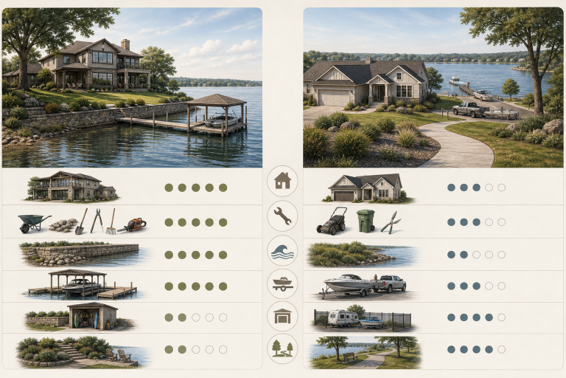
If you’re looking at lakefront property, plan around three things beyond the purchase price:
• Dock permitting. The Brazos River Authority governs docks on Lake Granbury, and a private dock requires a BRA permit on top of any city or Hood County building permit and HOA approval if the lot sits inside one. Permits come with rules on setback from property lines, size and height limits, and construction materials. If a dock is the reason you’re buying lakefront, build a permit contingency into your offer rather than assuming approval — a survey and site plan speed the process, but it isn’t instant.
• Flood insurance. Not every lakefront lot on Lake Granbury sits inside a mapped 100-year floodplain, but a meaningful share do, and if yours does, your lender will require flood coverage before closing. Check the property against the City of Granbury or Hood County flood map and FEMA’s current Flood Insurance Rate Map before you write an offer, not after. Even homes that sit just above the mapped floodplain often carry flood coverage voluntarily, since shoreline erosion and stormwater runoff are real considerations on a reservoir like this one.
• Elevation and construction rules. If you’re building or substantially remodeling on a lakefront lot, expect a floodplain development permit and an elevation certificate showing the finished floor sits above base flood elevation. This is a conversation for your builder and the county, not something to guess at.
If you’re looking at lake-access property, the questions shift:
• What does “access” actually include? A boat ramp is not the same as a community dock with slips, and a slip is not the same as dry storage for your trailer. Ask exactly what the HOA guarantees versus what’s first-come, first-served.
• What are total carrying costs? Add the monthly or annual dues to any working capital contribution due at closing, and compare that total — not just the sticker price — against a lakefront home’s higher purchase price and property taxes.
• Is there a waitlist? Some of the more popular lake-access communities near Granbury limit slip assignments, and a wait for a dock slip is common in a fast-growing lake market.
On the insurance and financing side, both paths deserve a phone call before you’re under contract. A lakefront home’s insurance quote depends heavily on its flood zone designation, so get a quote before your option period runs out — not after you’re already committed. A lake-access home usually skips the flood insurance requirement unless it happens to sit in a mapped zone itself, but your lender will still want to see the HOA’s insurance and financials, since a poorly funded HOA can affect resale value down the line.
Since Texas is a non-disclosure state, exact sold prices for either type of property aren’t published anywhere public — Zillow “Zestimates” and public tax records will only get you so far. If you want to know what a comparable lakefront lot on your stretch of shoreline actually closed for, or what a lake-access home in a specific Granbury community sold for last quarter, that’s data an agent pulls from the MLS, not something you’ll find with a Google search. It’s one of the more common questions we field from buyers weighing this exact trade-off, and it’s usually the deciding factor once they see real numbers side by side.
For sellers, the split matters just as much. A true lakefront listing should be priced and marketed around its shoreline and dock potential — buyers actively searching for waterfront will pay for it if the listing makes the frontage and any existing permits clear. A lake-access listing sells on a different story: proximity, amenities, and value relative to the lakefront homes nearby. Pricing either one off the wrong comp set is a common way sellers leave money on the table or sit on the market longer than they should.
Frequently Asked Questions
Does every lakefront home on Lake Granbury come with an existing dock?
No. Some lakefront lots have a dock already permitted and built, while others are undeveloped waterfront with no dock in place. If a dock matters to you, confirm during your option period whether one exists, whether it’s permitted correctly through the Brazos River Authority, and whether that permit transfers to a new owner.
Is flood insurance required on every lakefront property in Granbury?
Not automatically — it depends on whether the specific lot falls inside a mapped flood zone on the FEMA Flood Insurance Rate Map or the local floodplain map. If it does, your lender will require coverage before closing. Even homes just outside the mapped zone often carry voluntary coverage given the property’s proximity to the water.
Are HOA dues always lower in lake-access communities than owning a lakefront dock?
Not necessarily. Monthly dues in lake-access communities can look low on paper, but special assessments for ramp or dock repairs, plus a working capital contribution at closing, can add up to a real cost. Compare total carrying costs, not just the advertised dues figure, before deciding.
Can I add a private dock later if I buy a lake-access home instead of lakefront?
Generally, no — lake-access properties don’t include private shoreline, so there’s no frontage to build a private dock on. Your water access stays tied to whatever the community’s shared ramp, dock, or marina arrangement provides.
How much more does a lakefront home cost compared to a similar lake-access home in Granbury?
The premium varies by lot, frontage width, and view, but waterfront property nationally tends to sell well above comparable inland or access-only homes, and Granbury follows that pattern. Because Texas doesn’t publish exact sold prices, the most reliable way to see the real gap for a specific stretch of shoreline is to have an agent pull recent comparable sales from the MLS.
Whichever direction you’re leaning, the decision comes down to how much you value private water frontage versus a lower price and shared amenities — and that’s a trade-off worth running against real numbers for your specific budget and timeline. We walk Granbury buyers and sellers through this comparison regularly, matching lot type, permit status, and flood zone to what actually fits their plans. If you’re thinking through this for your own situation, we’re happy to walk you through the numbers. Reach out anytime.
About The Chad Smith Team
The Chad Smith Team at Realty of America is one of the top-producing real estate teams in the Dallas-Fort Worth Metroplex, with more than 22 years of experience, 2,915 homes sold, and recognition by RealTrends among the top 1% of real estate professionals nationwide. The team helps first-time buyers, sellers, relocation clients, and new construction buyers throughout Arlington, Mansfield, Fort Worth, Midlothian, Waxahachie, and surrounding DFW communities. Through this blog, the Chad Smith Team shares expert market insights and practical advice to help North Texas buyers and sellers make informed real estate decisions.