Full-Time vs. Second-Home Ownership on Lake Granbury: What It Actually Costs
Is It Cheaper to Live on Lake Granbury Full-Time or Own It as a Second Home?
Living on Lake Granbury full-time is almost always the better financial move if you can make the commute work — you qualify for the Texas homestead exemption, you get better mortgage terms, and you’re not paying for a house that sits empty five days a week. A second home costs more to finance and insure, but it skips the 40-plus-mile commute to Fort Worth and lets you treat the lake as a retreat rather than a daily reality. The right answer depends on your job, your commute tolerance, and whether you want rental income to help offset the cost.
By The Chad Smith Team | October 7, 2026
Lake Granbury pulls people in two directions. Some buyers want out of DFW traffic for good and are ready to make the lake their permanent address. Others just want a place to unwind on weekends without giving up a Fort Worth or Dallas paycheck.
Both are common. But they lead to very different numbers on the closing statement, on your tax bill, and on your monthly mortgage payment. Here’s how full-time ownership and second-home ownership actually compare on Lake Granbury, Hood County.
The Price Gap: Waterfront vs. Non-Waterfront
Location on or off the water is the single biggest price driver on Lake Granbury, whether you’re buying full-time or part-time.
• Waterfront homes: There are typically well over 150 waterfront listings active on Lake Granbury at any given time, with median list prices sitting around the high $300,000s — though individual lots swing dramatically based on dock access, bulkhead condition, and lake frontage.
• Non-waterfront Granbury homes: The broader Granbury market has recently run in the $348,000 to $385,000 range for median sale price, with average per-square-foot pricing around $371 for single-family homes citywide. Waterfront lots command a real premium above that baseline.
If you’re buying full-time, you have more flexibility to look a few streets back from the water and still get lake access through a community boat ramp or marina, which stretches your budget further. If the whole point is a dock and a view every time you show up, you’re paying for waterfront regardless of how often you’re actually there — and that math changes the second-home equation.
Property Taxes: The Homestead Exemption Only Applies to Full-Time Owners
This is where full-time ownership pulls ahead in a way a lot of second-home buyers don’t expect.
Hood County’s median effective property tax rate runs around 0.93% — meaningfully lower than the roughly 1.6% statewide average, which is already one reason Lake Granbury draws people out of higher-tax DFW counties. But the bigger factor is the homestead exemption, and it only applies to your primary residence.
• Texas voters approved a school-district homestead exemption increase to $140,000 in November 2025, building on the prior $100,000 exemption, which reduces the taxable value of a primary home before the school tax rate is even applied.
• A second home on Lake Granbury gets none of that. You pay property tax on the full appraised value, at the full rate, with no exemption cushion.
On a $400,000 lake home, that difference alone can run into the thousands of dollars a year. If you’re on the fence between full-time and part-time ownership, run this number with your lender or a local tax professional before you decide — it’s often bigger than people expect.
Insurance and Flood Zones: Know Before You Write the Offer
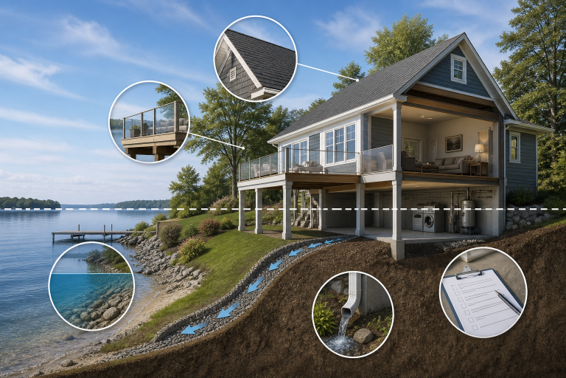
Most properties that actually touch Lake Granbury or the Brazos River fall at least partially inside a Special Flood Hazard Area. You’ll see two zone designations come up constantly in listings:
• Zone AE — the 1% annual chance (“100-year”) floodplain
• Zone X (shaded) — the 0.2% annual chance (“500-year”) floodplain
If you’re financing with a federally backed mortgage and the home sits in an SFHA, flood insurance isn’t optional — it’s required at closing. Riverfront and low-lying lakefront homes in Zone AE typically carry higher flood premiums than comparable homes in Zone X, though every lot is different enough that you’ll want a flood zone determination pulled before you fall in love with a specific property.
Lake Granbury itself is managed by the Brazos River Authority through the De Cordova Bend Dam, which controls lake level and outflow. That’s worth understanding whether you live there full-time or visit on weekends, since it affects dock usability and shoreline conditions during drought or heavy-rain periods.
For second-home buyers, insurance costs matter even more per day of actual use — you’re paying a full year of premiums for a property you might occupy 40 or 50 nights a year.
The Commute Question: What Full-Time Ownership Really Means
This is the trade-off that decides most of these purchases before taxes or insurance even come up.
• Granbury to Fort Worth: about 40 miles, typically 45–55 minutes on a normal weekday morning
• Granbury to Dallas: roughly 70 miles, around an hour and 20 minutes
• Granbury to DFW Airport: about 65 miles
If you work downtown Fort Worth or in Dallas, that’s a real daily commitment — not a dealbreaker, but not nothing. Some full-time Lake Granbury residents work remotely or locally in Hood County and never touch that drive. Others do it happily because the trade is worth it. Know which one you are before you commit to full-time ownership, because the commute is the thing that turns “great weekend house” into “why did we do this to ourselves” fastest.
If you’re relocating into the DFW area more broadly and still weighing where full-time living fits your budget, it’s worth comparing the cost of living in a closer-in suburb like Mansfield against what you’d save — or spend — living out at the lake full-time.
Financing: Second Homes Cost More to Borrow Against
Lenders treat second homes as higher risk than a primary residence, and it shows up in two places:
• Down payment: Primary-residence loans can go as low as 3% down for qualified buyers. Second-home loans typically require at least 10% down, and often 20–25% depending on your credit profile and debt-to-income ratio.
• Interest rate: Second-home mortgage rates generally run about 0.25% to 0.75% higher than primary-residence rates. Buyers with strong credit and a larger down payment tend to land at the low end of that range.
On a $400,000 loan, even a 0.5% rate difference adds real money to your payment every month for the life of the loan — on top of the larger down payment you’re already putting down. This is one of the first questions your lender will walk through with you, and it’s worth getting pre-qualified both ways before you decide which path to pursue.
Short-Term Rentals: A Way to Offset a Second Home’s Cost
If the plan is to rent the property out when you’re not using it, Granbury does allow short-term rentals and bed-and-breakfast use with a permit. The city amended its zoning rules in January 2024 to remove the Specific Use Permit requirement on residential-zoned property, which simplified the process. Permits are issued annually and must be renewed, so it’s not a one-time application.
A few things to check before you count on rental income to offset your carrying costs:
• Whether your specific street or subdivision has an HOA with its own short-term rental restrictions, separate from the city’s rules
• Whether dock and boat access are transferable to renters or restricted to owners
• Current permit fees and renewal requirements through the City of Granbury
This is exactly the kind of detail that’s easy to assume and expensive to get wrong. If short-term rental income is part of your decision to buy a second home instead of moving full-time, verify the rules on that exact property before you write an offer.
Which Ownership Path Makes Sense for You
There’s no universally right answer here — it comes down to your commute tolerance, your job flexibility, and how much of the year you’d actually spend at the lake.
Full-time ownership wins on the numbers: the homestead exemption, a lower total insurance-and-tax burden per year of use, and better financing terms. Second-home ownership wins on flexibility: you keep your DFW job and income without the daily drive, and short-term rental income can help offset the higher carrying costs if the permitting and HOA rules line up.
Your specific number — what you’d pay full-time versus part-time on a particular property — depends on the lot, the flood zone, and your financing profile. That’s where running the actual comparison with someone who knows this market makes the difference between a guess and a decision.
If you’re weighing a move to Lake Granbury and need help coordinating logistics once you’ve decided, a good moving company familiar with the DFW Metroplex can make the transition a lot smoother, whether you’re relocating full-time or just furnishing a weekend place.
Frequently Asked Questions
Can I get a homestead exemption on a Lake Granbury second home?
No. The Texas homestead exemption only applies to your primary residence — the home you actually live in full-time. A second or vacation home on Lake Granbury is taxed on its full appraised value with no exemption reduction, which is one of the biggest cost differences between the two ownership paths.
Do all Lake Granbury homes require flood insurance?
Not all, but many. Most properties that touch the lake or the Brazos River fall at least partially within a Special Flood Hazard Area, and flood insurance is required if you have a federally backed mortgage on a home in that zone. Get a flood zone determination on the specific property before you assume either way.
Is it realistic to commute from Granbury to Fort Worth or Dallas every day?
Fort Worth is a manageable daily commute for many people at around 40 miles and 45–55 minutes each way. Dallas is a longer commitment at roughly 70 miles and over an hour. Whether it’s realistic depends on your schedule, your job’s flexibility, and how much daily drive time you’re willing to accept long-term.
Can I rent out my Lake Granbury home short-term to offset the cost?
Yes, with a permit. Granbury allows short-term rentals and bed-and-breakfast use on residential property, and the city simplified its permitting process in 2024. Permits are annual and must be renewed, and your specific subdivision may have HOA rules that add further restrictions, so check both before counting on rental income.
Is it more expensive to finance a second home than a primary residence on Lake Granbury?
Generally, yes. Second-home mortgages typically carry interest rates about 0.25% to 0.75% higher than primary-residence loans and require larger down payments, often 10% to 25% or more, because lenders view second homes as higher risk than a primary residence.
If you’re thinking through full-time versus second-home ownership on Lake Granbury for your own situation, we’re happy to walk you through the actual numbers on a specific property — taxes, insurance, financing, and what it nets out to either way. Reach out anytime.
About The Chad Smith Team
The Chad Smith Team at Realty of America is one of the top-producing real estate teams in the Dallas-Fort Worth Metroplex, with more than 22 years of experience, 2,915 homes sold, and recognition by RealTrends among the top 1% of real estate professionals nationwide. The team helps first-time buyers, sellers, relocation clients, and new construction buyers throughout Arlington, Mansfield, Fort Worth, Midlothian, Waxahachie, Granbury, and surrounding DFW communities. Through this blog, the Chad Smith Team shares expert market insights and practical advice to help North Texas buyers and sellers make informed real estate decisions.