Condo vs. Single-Family in Fort Worth’s Urban Core
Is a Condo or Single-Family Home a Better Buy in Downtown Fort Worth?
A condo in downtown Fort Worth typically costs more per square foot (around $278/sq ft, median list price near $419K) but includes exterior maintenance and comes with monthly HOA dues of roughly $500–$1,200. A single-family home in Near Southside or the historic neighborhoods just south of downtown runs closer to a $287K median sale price, puts yard and roof upkeep on you, but skips (or minimizes) HOA dues. The right choice comes down to how much you value low-maintenance living versus private space and long-term cost control.
By The Chad Smith Team | October 7, 2026
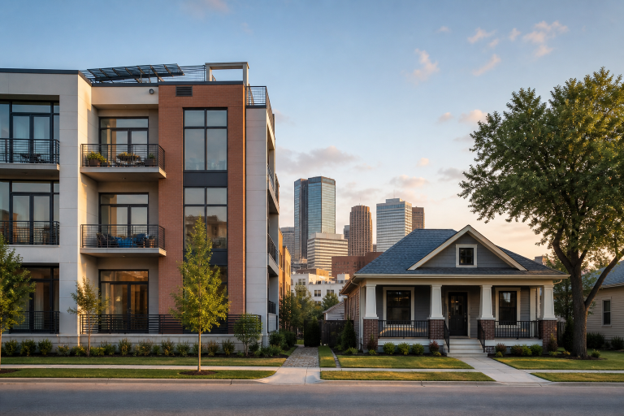
If you’re weighing a condo against a house in Fort Worth’s urban core, you’re really weighing two different ownership experiences, not just two price tags. One trades a mortgage payment for a mortgage payment plus a monthly HOA bill. The other trades that HOA bill for a Saturday spent on the lawn mower and, eventually, a roof.
We get this question constantly from buyers looking at downtown, West 7th, the Cultural District, and the historic neighborhoods just south of Magnolia Avenue — Fairmount, Berkeley Place, and Ryan Place. Here’s what the numbers and the day-to-day trade-offs actually look like.
What You’ll Actually Pay: Price, HOA Dues, and Taxes
Start with the sticker price. Downtown Fort Worth condos have carried a median list price around $419,000, working out to roughly $278 per square foot in recent data. That’s a premium over the broader Fort Worth market, where the citywide median list price sits closer to $349,000.
Move a few blocks south into Near Southside and the historic core neighborhoods, and single-family pricing tells a different story. The Southside area’s median sale price runs around $287,000, with an average closer to $340,000 once you account for the mix of small historic cottages and larger renovated or new-build homes. Prices there range widely — from around $135,000 up to $2.5 million — because you’re looking at everything from a 1920s Craftsman bungalow in Fairmount to a fully rebuilt home in Berkeley Place or Ryan Place. Homes in this stretch spend about 55 days on market on average, so it’s not an instant-sale environment either way.
The bigger monthly gap isn’t the mortgage — it’s what rides alongside it.
Condo HOA dues downtown typically fall in the $500–$1,200/month range, depending on the building’s age, amenities, and how much of the maintenance budget is baked into your dues. Some smaller or older conversions run lower, closer to $300–$500/month, but don’t assume that without checking. Before you write an offer on any downtown condo, ask for the HOA’s current budget, reserve study, and the last 12–24 months of board minutes. A building with underfunded reserves can hit owners with a special assessment that erases whatever you saved on the purchase price.
Single-family homes in Fairmount, Berkeley Place, and Ryan Place generally carry no structural HOA at all — some neighborhoods have light, voluntary associations, but you won’t find a monthly bill covering roof and exterior maintenance the way a condo does. You’re on the hook for that upkeep yourself, but you’re also not funding someone else’s reserve account.
On property taxes, condos and houses in the urban core are taxed the same way. Tarrant County appraises real property on an ad valorem basis, and the combined rate for a Fort Worth property — city, county, Fort Worth ISD, Tarrant County College, and JPS Health — runs roughly 2.2%–2.24% of taxable value. What changes your bill is the appraised value of your specific unit or home, not whether it’s a condo or a house. Homestead exemptions apply either way: the Fort Worth ISD school exemption reduces your taxable value by $140,000, Tarrant County and JPS each offer a 10% homestead exemption, and the City of Fort Worth offers 20% off city taxes — all filed by the April 30 deadline. If you want a fuller breakdown of how Tarrant County’s rates stack up against neighboring cities, we walked through that in our comparison of property tax rates across Mansfield, Arlington, and Fort Worth.
Maintenance and Lifestyle: Lock-and-Leave vs. Yard Work

This is the trade-off that actually decides most condo-vs-house conversations, more than price.
Downtown condos come in a few flavors, and the maintenance picture shifts with each:
• Converted lofts in old warehouses and office buildings offer exposed brick and character, but parking arrangements vary and the HOA budget leans heavily on maintaining an older structure.
• Mid-rise purpose-built condos (typically 4–8 stories) often include amenities like a fitness room or common lounge, with HOA fees reflecting what’s covered — insurance, exterior upkeep, sometimes utilities.
• High-rise units are limited in supply downtown but bring more amenities — and higher dues to match.
• Live/work and mixed-use units, concentrated near West 7th, put you steps from retail and dining but come with their own leasing and financing quirks.
In every one of these, the HOA carries the exterior, the roof, and the structural stuff. You pay an HO-6 policy for your interior and belongings, but you’re not the one calling a roofer. That’s the appeal for buyers who want a lock-and-leave lifestyle — lock the door, travel, and not think about gutters.
A single-family home in Fairmount, Berkeley Place, or Ryan Place flips that. You get a private yard, your own driveway or garage, and full control over renovations — no HOA architectural committee to clear changes with. But you’re also the one budgeting for the roof, the foundation (a real consideration in homes built in the 1900s–1930s), and routine yard maintenance. Homes in these neighborhoods carry real character — Craftsman, Prairie, and Tudor styles on lots that range from compact to genuinely deep — but character comes with upkeep.
Neither option is objectively lower cost over time. A well-run condo with healthy reserves can be a very predictable monthly expense. A single-family home with a newer roof and foundation can go years without a major bill. The honest answer is that you’re trading predictability for one kind of freedom or another.
Location, Parking, and Getting Around the Core
Both options put you close to the same amenities — Sundance Square, the Cultural District’s museums, West 7th’s restaurants and shops — but you’ll experience the core differently.
Downtown parking has a few built-in breaks: meters are free after 6 p.m. on weekdays and all day on weekends, and the Downtown TIF District offers free self-parking in select garages during those same windows. Still, most condo buyers should confirm whether their unit includes a deeded parking space or an assigned one — this affects both convenience and resale value down the line.
The Cultural District is walkable for short trips between museums, parks, and restaurants, and Trinity Metro’s bus network plus TEXRail commuter rail connect through Fort Worth Central Station, which matters if you’re commuting into the core rather than out to the suburbs. If you’re weighing an urban-core home against a longer commute from a suburban market, our breakdown of commute times from Mansfield into Dallas-Fort Worth is worth a look for context on what you’re trading location for.
The historic neighborhoods just south of downtown offer a more walkable, bikeable street grid of their own, with driveway or street parking rather than a structured garage — a different kind of convenience, but convenience nonetheless.
Which One Fits Your Situation
If you want low-maintenance ownership, don’t mind a monthly HOA bill, and plan to travel or work outside Fort Worth often, a downtown or Cultural District condo is worth serious consideration — just go in with the HOA’s financials in hand.
If you want private outdoor space, more control over renovations, and you’re comfortable budgeting for your own maintenance, a single-family home in Near Southside, Fairmount, Berkeley Place, or Ryan Place gives you that at a comparable — sometimes lower — monthly cost once HOA dues are factored in.
Financing looks different too. Condo purchases often require your lender to confirm the building meets Fannie Mae, Freddie Mac, or FHA condo-project approval, along with checking owner-occupancy ratios and reserve funding. That’s an extra step single-family financing doesn’t require, and it can affect your timeline. Your specific numbers — what you’ll actually net, what your monthly payment looks like with taxes and dues included, and how a particular building or block compares — depend on the property you’re looking at. That’s exactly the kind of side-by-side we walk buyers through before they write an offer.
Frequently Asked Questions
Are HOA dues tax-deductible on a Fort Worth condo?
Generally, no — HOA dues on a primary residence aren’t deductible the way mortgage interest or property taxes can be. Talk to a tax professional about your specific situation, since rules can vary if the unit is a rental or investment property.
Do condos in downtown Fort Worth appreciate as well as single-family homes?
Appreciation depends heavily on the building’s reputation, HOA health, and the specific neighborhood, not just the property type. Condo markets in the core generally have a smaller buyer pool than single-family markets, which can mean longer days on market in softer conditions — ask us for current trends on a specific building before you buy.
Is it harder to get a mortgage for a condo than a house in Fort Worth?
It can involve an extra step. Lenders typically need to confirm the condo project itself is approved (Fannie Mae, Freddie Mac, or FHA guidelines), and they’ll look at the building’s owner-occupancy rate and reserve funding. Single-family financing doesn’t carry that building-level review.
What should I ask for before buying a downtown Fort Worth condo?
Request the HOA’s current budget and financial statements, the reserve study if one exists, board meeting minutes from the last 12–24 months, the insurance declarations, and any record of recent special assessments. This tells you whether the building is financially healthy or heading toward a surprise bill.
Do single-family homes near downtown Fort Worth have any HOA at all?
Some do — the historic neighborhoods around Fairmount, Berkeley Place, and Ryan Place sometimes have light, voluntary neighborhood associations, but these are typically far less costly than a condo HOA and don’t cover structural maintenance on your home.
If you’re thinking through this decision for your own move, we’re happy to walk you through the actual numbers on specific buildings and blocks — reach out anytime, and we’ll help you compare real options side by side.
About The Chad Smith Team
The Chad Smith Team at Realty of America is one of the top-producing real estate teams in the Dallas-Fort Worth Metroplex, with more than 22 years of experience, 2,915 homes sold, and recognition by RealTrends among the top 1% of real estate professionals nationwide. The team helps first-time buyers, sellers, relocation clients, and new construction buyers throughout Arlington, Mansfield, Fort Worth, Midlothian, Waxahachie, and surrounding DFW communities. Through this blog, the Chad Smith Team shares expert market insights and practical advice to help North Texas buyers and sellers make informed real estate decisions.