A Beginner’s Guide to Reading a Mansfield Property Tax Statement
How do you read a property tax statement in Mansfield, TX?
A Mansfield property tax statement has three parts that matter most: the appraised value set by the Tarrant Appraisal District, the exemptions that lower your taxable value (like the homestead exemption, which reduces your school-district taxable value by $140,000 in 2026), and the list of taxing units — the county, city, school district, and special districts — each charging its own rate. Your total bill is the sum of every taxing unit’s rate applied to your taxable value after exemptions. The appraisal district decides your value; the Tarrant County Tax Office sends the bill and takes the payment.
By The Chad Smith Team | September 2, 2026

If you’ve just bought a home in Mansfield — or you’re about to — your first property tax statement can look like a wall of numbers and agency names. It’s actually more readable than it seems, once you know what each line is doing.
Here’s a plain-language walkthrough of what’s on the statement, who’s behind each part, and how the final number is built.
Two offices, two jobs
The most useful thing to understand first is that two different entities are involved, and they do different things:
• The Tarrant Appraisal District (TAD) decides what your property is worth for tax purposes and administers your exemptions. If you disagree with your value, this is who you protest to.
• The Tarrant County Tax Office sends the actual bill, collects payment, issues receipts, and tracks your account balance. If you have a question about paying, a receipt, or a refund, this is who you contact.
Keep that split in mind and half the confusion disappears. Value questions go to TAD; billing and payment questions go to the Tax Office.
The three numbers that matter
1. Appraised (or market) value. This is TAD’s estimate of what your property is worth as of January 1 of the tax year. Your record typically breaks it into land value and improvement value (the house and structures), which add up to the total. This is the starting point for everything else.
2. Exemptions. Exemptions reduce the value that actually gets taxed. The big one for most homeowners is the homestead exemption on your primary residence, which in 2026 reduces your school-district taxable value by $140,000. Other exemptions exist for homeowners who are 65 or older, disabled, or qualifying veterans. Your statement lists which exemptions are applied to your property — and it’s worth confirming your homestead exemption is actually on file, because it makes a real difference.
3. Taxable value. This is your appraised value minus your exemptions — the number the tax rates are actually applied to. Two identical homes can have different taxable values if one has a homestead exemption and the other doesn’t.
There’s also a Texas rule worth knowing: once you have a homestead exemption, the taxable value of your homestead generally can’t rise more than 10% per year, even if the market value jumps more. That cap can make your taxable value lower than your appraised value over time.
The taxing units: where your bill comes from
Here’s the part that surprises new homeowners. There isn’t one “Mansfield property tax.” Your bill is the combined total of several separate taxing units, each setting its own rate and each taxing the same property.
Tarrant County has dozens of taxing units, and a typical Mansfield homeowner’s bill reflects several of them, which may include:
• Tarrant County and related county units
• Your city (the municipal rate for your address)
• Your school district — usually the single largest slice
• Tarrant County College District
• JPS Health Network (the county hospital district)
• Any special districts that apply to your parcel
Your statement lists each taxing unit, its rate, and the amount you owe that unit. Add them together and you get your total bill. Because the school district is usually the biggest piece, the homestead exemption — which specifically cuts your school taxable value — carries a lot of weight.
How the math actually works
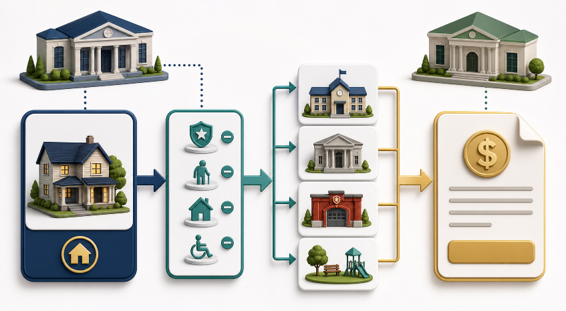
Put simply, for each taxing unit:
Taxable value ÷ 100 × that unit’s tax rate = what you owe that unit.
Rates are quoted per $100 of value. Add up what you owe across every unit, and that’s your annual property tax. Your statement does this math for you — this is just so the numbers make sense when you look at them.
A few things to check every year
When your statement or appraisal notice arrives, it’s worth a quick review:
• Is your homestead exemption applied? If you bought recently, confirm it’s on file for your primary residence.
• Did your appraised value jump? Compare it to last year and to what similar homes are valued at. If it looks off, you have the right to protest with TAD by the deadline.
• Are all the taxing units correct for your address?
• Do you qualify for any additional exemptions — over-65, disability, or veteran?
For a fuller picture of rates and how Mansfield compares, our guide to Tarrant County property taxes for Mansfield homeowners goes deeper, and our breakdown of property taxes across Mansfield, Arlington, and Fort Worth shows how location changes the total.
The honest bottom line
A Mansfield property tax statement isn’t as intimidating as it first looks. Find your appraised value, subtract your exemptions to get your taxable value, then see how the taxing units each apply their rate to build your total. Remember that TAD sets your value and the Tarrant County Tax Office collects the bill — and that your homestead exemption and the 10% cap are your two biggest friends as a homeowner.
If you’re new to Mansfield and want help making sense of your statement — or figuring out what your taxes might look like on a home you’re considering — we’re always glad to walk through it with you. Reach out anytime.
Frequently Asked Questions
Who sets my property value in Mansfield — the city or the county?
Neither directly. The Tarrant Appraisal District (TAD) sets your property’s appraised value and administers exemptions. The Tarrant County Tax Office then bills and collects based on that value and the rates set by each taxing unit. Value disputes go to TAD; billing questions go to the Tax Office.
What is the homestead exemption worth in 2026?
For 2026, the homestead exemption reduces your school-district taxable value by $140,000 on your primary residence. Because school taxes are usually the largest part of your bill, this exemption has a significant effect. Other exemptions are available for homeowners who are 65 or older, disabled, or qualifying veterans.
Why does my tax bill list so many different entities?
Your total property tax is the combined bill from several taxing units that all cover your property — typically the county, your city, your school district, Tarrant County College, JPS Health Network, and any special districts. Each sets its own rate, and your statement shows the amount owed to each.
What’s the difference between appraised value and taxable value?
Appraised value is what TAD estimates your property is worth. Taxable value is that amount minus your exemptions — it’s the figure the tax rates are actually applied to. With a homestead exemption in place, your taxable value can’t generally rise more than 10% per year even if market value climbs faster.
What should I do if my appraised value looks too high?
You have the right to protest your value with the Tarrant Appraisal District by the annual deadline. Compare your appraised value to prior years and to similar nearby homes, and gather any evidence that supports a lower value before you file.
About The Chad Smith Team
The Chad Smith Team at Realty of America is one of the top-producing real estate teams in the Dallas-Fort Worth Metroplex, with more than 22 years of experience, 2,915 homes sold, and recognition by RealTrends among the top 1% of real estate professionals nationwide. The team helps first-time buyers, sellers, relocation clients, and new construction buyers throughout Arlington, Mansfield, Fort Worth, Midlothian, Waxahachie, and surrounding DFW communities. Through this blog, the Chad Smith Team shares expert market insights and practical advice to help North Texas buyers and sellers make informed real estate decisions.