Will You Owe Capital Gains Tax Selling Your Mansfield, TX Home?
Do You Pay Capital Gains Tax When You Sell Your House in Texas?
Texas has no state capital gains tax, but you may still owe federal capital gains tax on your profit unless you qualify for the primary residence exclusion. That exclusion lets single filers exclude up to $250,000 of gain, and married couples filing jointly exclude up to $500,000, as long as you owned and lived in the home for at least two of the last five years. For most Mansfield sellers, especially those who've owned their home a few years, this exclusion covers the entire gain — but it's worth running your specific numbers before you list.
By The Chad Smith Team | July 22, 2026
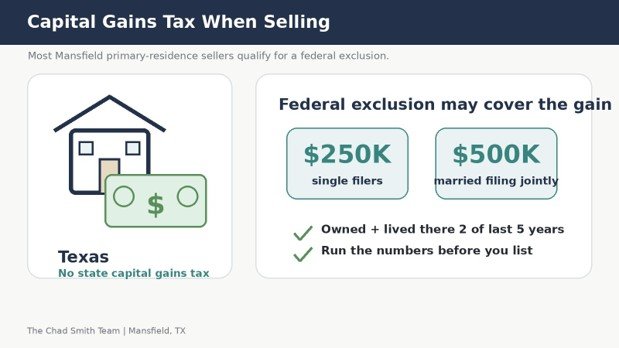
Most Mansfield primary-residence sellers benefit from Texas having no state capital gains tax and the federal home-sale exclusion.
If you've owned your home for even a few years, there's a good chance it's worth meaningfully more than you paid for it. That's good news for your sale price, but it also raises a fair question: will you owe taxes on that gain?
The Texas Advantage
Start with the good news: Texas does not levy a state capital gains tax. Whatever you owe on the sale of your home will be a federal tax question only, not a state one — which already puts Texas sellers ahead of homeowners in many other states.
The Federal Exclusion Most Sellers Qualify For
The IRS lets homeowners exclude a significant portion of their gain from federal capital gains tax, provided they meet the ownership and use test:
You owned the home for at least two years within the five years before the sale
You lived in the home as your primary residence for at least two years within that same five-year period
The two years don't need to be consecutive
If you meet these requirements, single filers can exclude up to $250,000 of gain, and married couples filing jointly can exclude up to $500,000. For most sellers in Mansfield's current price range, that exclusion covers the entire profit on the sale, meaning no federal capital gains tax is owed at all.
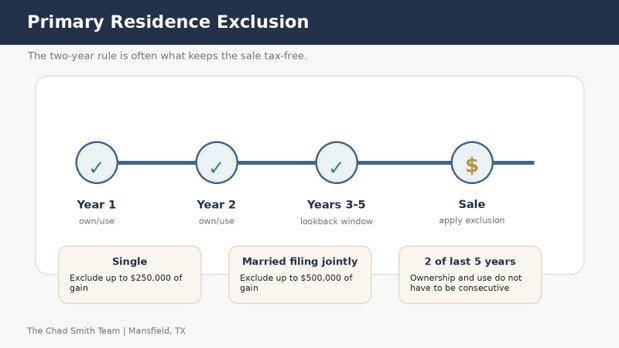
The federal primary residence exclusion depends on the two-of-five-year ownership and use test.
How to Calculate Your Actual Gain
Your taxable gain isn't simply your sale price minus your purchase price. It's your sale price minus your cost basis, which includes:
What you originally paid for the home
The cost of significant capital improvements you've made over the years — a new roof, a major renovation, an addition (routine maintenance and repairs don't count)
Certain selling costs, like agent commissions and closing costs
Keeping records of major improvements over the years you've owned the home can meaningfully reduce your taxable gain if you end up above the exclusion threshold.
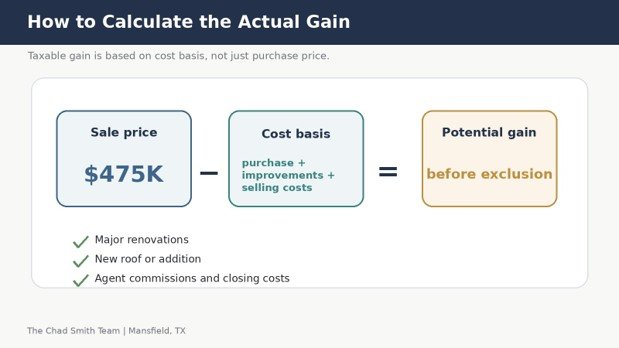
Your taxable gain depends on cost basis, which can include purchase price, capital improvements, and certain selling costs.
When You Might Still Owe Something
Your gain exceeds the exclusion amount. If you've owned your home a long time in an area that's appreciated significantly, or you're a single filer with a large gain, you could have taxable profit above the $250,000 or $500,000 threshold.
You don't meet the two-year ownership or residency requirement. If you're selling sooner than that, you generally won't qualify for the full exclusion.
The home wasn't your primary residence. Investment properties and second homes don't qualify for this exclusion at all.
The Partial Exclusion Exception
Even if you don't meet the full two-year requirement, you may still qualify for a partial exclusion if the primary reason for your sale involves a change in workplace location, a medical issue, or another unforeseeable circumstance. This is worth discussing with a tax professional if you're selling sooner than planned due to circumstances outside your control.
What This Looks Like for a Typical Mansfield Seller
Say you bought a home in Mansfield for $350,000 several years ago and it's now selling for $475,000 — a gain of roughly $125,000 before accounting for selling costs and any capital improvements. For the vast majority of sellers, that's comfortably under the $250,000 single-filer exclusion, let alone the $500,000 joint-filer exclusion. In most cases, no federal capital gains tax is owed on a gain of this size.
The math changes for sellers who've owned longer, made a larger initial investment, or are selling a significantly appreciated property. That's where it's worth running your specific numbers rather than assuming.
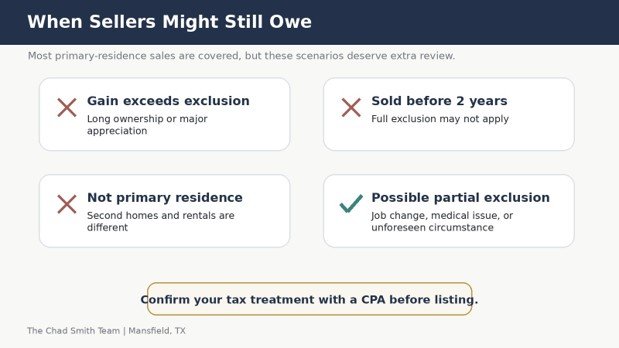
Some Mansfield sellers may still need CPA guidance if their gain is large, they sell early, or the home was not their primary residence.
The Bottom Line
Most Mansfield homeowners selling their primary residence won't owe federal capital gains tax, thanks to the exclusion and Texas's lack of a state-level tax. But "most" isn't "all," and the exclusion has real requirements around ownership, residency, and gain size. Before you list, it's worth understanding where your specific numbers fall — especially if you've owned the home for a long time or made substantial improvements you'll want documented.
We're not tax professionals and can't give you specific tax advice, but we can help you understand what your home is actually worth in today's market, which is the first number you need before this conversation with a CPA makes sense.
Frequently Asked Questions
Does Texas have a state capital gains tax on home sales?
No. Texas does not levy a state capital gains tax, so any capital gains tax owed on a home sale would be a federal tax matter only.
How much of my home sale profit can I exclude from federal taxes?
Single filers can exclude up to $250,000 of gain, and married couples filing jointly can exclude up to $500,000, provided they meet the ownership and residency requirements.
Do I need to have lived in my home for the full two years before selling?
The two years of residency don't need to be consecutive, but you generally need to have lived in the home as your primary residence for at least two of the five years before the sale to qualify for the full exclusion.
What counts toward my cost basis when calculating my taxable gain?
Your original purchase price, the cost of significant capital improvements like a new roof or major renovation, and certain selling costs like agent commissions all factor into your cost basis, which reduces your taxable gain.
What if I have to sell before meeting the two-year requirement?
You may still qualify for a partial exclusion if the sale is primarily due to a change in workplace location, a medical issue, or another unforeseeable circumstance. Confirm your specific situation with a tax professional.
If you're planning to sell and want to understand what your home is worth before you talk to a CPA about the tax side, we're happy to help. Reach out to the Chad Smith Team anytime.
About The Chad Smith Team
The Chad Smith Team at Realty of America is one of the top-producing real estate teams in the Dallas-Fort Worth Metroplex, with more than 22 years of experience, 2,915 homes sold, and recognition by RealTrends among the top 1% of real estate professionals nationwide. The team helps first-time buyers, sellers, relocation clients, and new construction buyers throughout Arlington, Mansfield, Fort Worth, Midlothian, Waxahachie, and surrounding DFW communities. Through this blog, the Chad Smith Team shares expert market insights and practical advice to help North Texas buyers and sellers make informed real estate decisions.