What Is a Seller Concession, and When Should You Offer One in Mansfield, TX?
What Is a Seller Concession in Real Estate?
A seller concession is money you agree to credit toward the buyer’s closing costs, prepaid items, or a mortgage rate buydown, instead of lowering your home’s sale price. The credit is negotiated as part of the purchase contract, capped by the buyer’s loan type, and paid through the title company at closing. In today’s Mansfield market, concessions are increasingly used to keep a deal together without cutting the list price sellers need to hit their bottom line.
By The Chad Smith Team | July 31, 2026

How a Seller Concession Actually Works
When a buyer makes an offer, they can ask you to contribute a set dollar amount — or a percentage of the sale price — toward costs they’d otherwise pay out of pocket at closing. That money doesn’t come to you and then get handed back. It’s applied directly to the buyer’s settlement statement by the title company, reducing what the buyer has to bring to the closing table.
Concessions typically cover:
• Closing costs — loan origination fees, appraisal and inspection fees, title charges, and recording fees
• Prepaid items — the first year of homeowners insurance, property tax escrow, and prepaid interest
• Rate buydowns — a lump sum applied to reduce the buyer’s mortgage interest rate, either temporarily (a 2-1 buydown) or for the life of the loan
• Repair credits — money credited in lieu of completing repairs identified during the option period
The negotiation happens inside the contract, and it’s spelled out clearly in the closing figures both sides review before signing. If you want a deeper look at how these numbers flow through the closing process, our post on understanding cash to close walks through exactly what a buyer sees on their final settlement statement.
Concession Limits by Loan Type in 2026
You can’t hand a buyer an unlimited credit. Every loan program caps how much a seller can contribute, and the cap is tied to the buyer’s financing:
• Conventional loans: 3% of the sale price if the buyer is putting down less than 10%, 6% with 10–24% down, and up to 9% with 25% or more down.
• FHA loans: capped at 6% of the lesser of the sale price or the appraised value.
• VA loans: normal closing costs paid on the buyer’s behalf have no cap, but concessions in the VA sense — things like paying off a buyer’s judgments or covering costs unrelated to the loan — are capped at 4% of the sale price.
Two things matter here. First, a concession can never exceed the buyer’s actual closing costs — you can’t hand over more than what’s actually owed. Second, in Texas, sellers customarily already pay for the owner’s title policy as part of standard practice, and that cost is separate from the buyer’s concession cap. Your agent and the title company will calculate the buyer’s real closing costs early so you know exactly how much room there is to negotiate before you agree to anything.
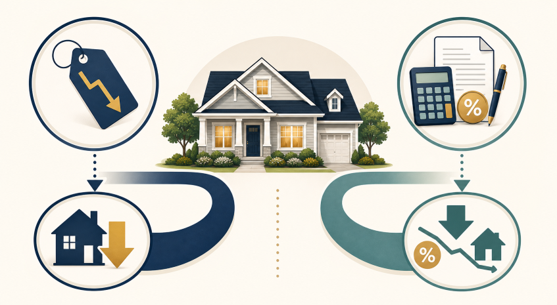
Seller Concessions vs. Lowering Your Price
These two moves look similar on paper — both put more money in the buyer’s pocket — but they work very differently, and the difference matters for your net proceeds and your home’s marketing.
A price reduction lowers everything. It lowers the appraisal target, lowers the comps future buyers and appraisers will use against your neighborhood, and lowers your net regardless of how the buyer finances the deal.
A concession is more targeted. The sale price — and the number that shows up in the county’s sold data your neighbors and future sellers will reference — stays intact. Only the buyer’s out-of-pocket cost changes. That’s why many sellers prefer concessions when they’re trying to protect their home’s recorded value and preserve strong comps for the block.
There’s also a real financial difference for the buyer, and it’s bigger than most people expect. A $10,000 price cut typically saves a buyer around $53 a month on their mortgage payment. A $10,000 credit applied to a temporary rate buydown can save that same buyer $200 or more a month during the first year or two of the loan. For a buyer stretching to make the payment work, the concession often solves their actual problem — monthly affordability — far more effectively than the price cut does.
The tradeoff: concessions are capped by loan type, as outlined above, while a price reduction has no such ceiling. If a buyer needs more relief than their loan program allows in concessions, a price adjustment may be the only lever left.
When Concessions Make Sense in Today’s Mansfield Market
DFW has shifted into a buyer’s market in 2026. Across the Metroplex, there are roughly twice as many sellers as active buyers, the median home price sits near $415,000, and homes are commonly taking 60 to 105 days to sell. A meaningful share of active DFW listings — by some counts, a third or more — have had at least one price reduction on file. Bidding wars are rare right now.
In that environment, a concession is often the smarter first move rather than the price cut. Here’s when it tends to make the most sense for Mansfield sellers:
• Your home has been on the market for a few weeks with strong showing traffic but no offers. Buyers may love the house but be stuck on the monthly payment. A rate buydown credit addresses that directly.
• You’re priced correctly for the neighborhood and don’t want to reset the comps. Offering a concession keeps your sale price — and the data future sellers on your street will reference — where you want it.
• The buyer’s biggest obstacle is cash to close, not the sale price itself. First-time buyers and move-up buyers in the $350,000–$500,000 range, which covers much of Mansfield’s active inventory, are frequently asking for closing cost help rather than a lower price.
• An appraisal comes in lower than the contract price. A concession can help bridge part of the gap without you having to drop your price outright. If you want more detail on how that situation typically plays out, see our post on what happens when a home appraisal comes in low.
• You’ve already priced competitively and a further price cut would put you below recent comparable sales. A concession lets you hold your number while still giving the buyer a reason to move forward.
Concessions aren’t automatically the right call. If your home is meaningfully overpriced for current conditions, no amount of closing cost credit will offset a list price buyers and appraisers won’t support — a price adjustment becomes the more honest fix. This is exactly the kind of call we walk sellers through before we even finalize a listing price, because getting it right the first time avoids repeated price cuts down the road.
How to Structure a Concession Offer
If you’re listing your home, you don’t have to decide on a concession strategy in a vacuum. A few practical approaches:
• Offer it proactively in the listing. Advertising a contribution toward closing costs or a rate buydown can widen your buyer pool, particularly for move-up buyers watching their monthly payment closely.
• Hold it in reserve for negotiation. Some sellers prefer to see what buyers ask for during the option period rather than advertising it upfront.
• Combine it with your Texas Seller’s Disclosure Notice review. Any known repair issues should be disclosed regardless of whether you offer a credit instead of fixing them — a concession doesn’t replace your disclosure obligations under Texas law.
Every one of these decisions ties back to your net proceeds, your timeline, and how your specific home compares to what else is active in Mansfield right now. That’s not a spreadsheet exercise — it’s a conversation grounded in current local data.
The Bottom Line
A seller concession lets you keep your sale price intact while still solving the buyer’s real obstacle — cash to close or monthly payment — which is often more valuable to them than a straight price cut. In a DFW market where buyers have more leverage and options than they’ve had in years, knowing when to offer one, and how much your buyer’s loan program actually allows, can be the difference between a stalled listing and a signed contract.
Frequently Asked Questions
Is a seller concession the same as a price reduction?
No. A price reduction lowers your home’s sale price and the comps tied to it. A seller concession keeps the sale price the same but credits money back to the buyer at closing to cover costs like closing fees, prepaids, or a rate buydown.
How much can I offer as a seller concession in Texas?
The amount is set by the buyer’s loan type, not by Texas law. Conventional loans allow 3–9% of the sale price depending on the buyer’s down payment, FHA allows up to 6% of the lesser of sale price or appraised value, and VA concessions are capped at 4% separate from uncapped standard closing costs.
Does offering a concession mean I’ll net less money?
Not necessarily. If the concession helps you sell at your list price instead of dropping the price outright, your net proceeds can end up higher than they would with an equivalent price cut, since the concession only offsets a portion of the buyer’s costs rather than reducing the total sale price.
Can a seller concession help if the appraisal comes in low?
It can help bridge part of the gap, though it doesn’t solve an appraisal shortfall on its own since lenders base the loan amount on the appraised value. Sellers often combine a modest price adjustment with a concession to get the deal to the closing table.
Should I offer a concession or lower my price in today’s Mansfield market?
It depends on why the home isn’t selling. If showings are strong but offers are stalling on affordability, a concession — especially a rate buydown — often solves the problem more efficiently than a price cut. If the home is overpriced for current comps, a price adjustment is usually the more direct fix.
If you’re weighing a concession against a price adjustment for your own Mansfield listing, we’re happy to run the numbers with you and show exactly how each option affects your net proceeds. Reach out to the Chad Smith Team anytime to talk through your specific situation.
About The Chad Smith Team
The Chad Smith Team at Realty of America is one of the top-producing real estate teams in the Dallas-Fort Worth Metroplex, with more than 22 years of experience, 2,915 homes sold, and recognition by RealTrends among the top 1% of real estate professionals nationwide. The team helps first-time buyers, sellers, relocation clients, and new construction buyers throughout Arlington, Mansfield, Fort Worth, Midlothian, Waxahachie, and surrounding DFW communities. Through this blog, the Chad Smith Team shares expert market insights and practical advice to help North Texas buyers and sellers make informed real estate decisions.