What Happens to Your Earnest Money If a Deal Falls Through in Mansfield, TX?
Who Keeps the Earnest Money If a Real Estate Deal Falls Through in Texas?
It depends on why the deal fell through and what your contract says. If you exercise your right to terminate during the option period, your earnest money is typically returned to you in full. If the deal closes, it's credited toward your purchase. If you breach the contract — for example, by failing to close without a valid reason — the seller may be entitled to keep it. In every case, the funds sit with a neutral third party, usually a title company, until both sides agree on where they go or a court decides.
By The Chad Smith Team | July 21, 2026
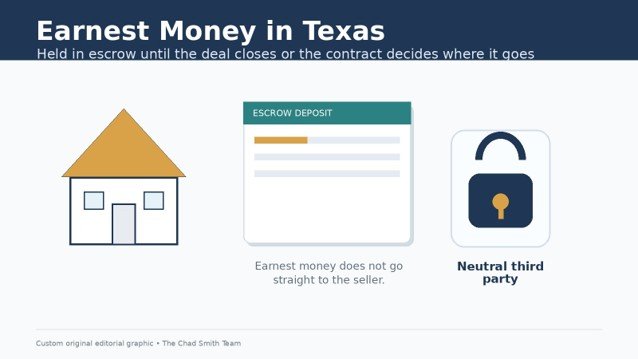
Earnest money is held by a neutral title company or escrow agent until the deal closes or the contract determines where the funds go.
Putting down earnest money is one of the first real financial commitments you make when buying a home, and it's natural to wonder what happens to it if things don't go as planned. Here's how it actually works in Texas.
What Earnest Money Actually Is
Earnest money is a deposit you make shortly after your offer is accepted, showing the seller you're serious about the purchase. In Texas, it typically ranges from 1% to 10% of the purchase price, though 1% is common on more moderately priced homes in Mansfield's market.
The money doesn't go to the seller directly. It goes to an escrow agent — usually the title company handling your closing — who holds it in a secure account until the deal closes or the contract terminates according to its terms.
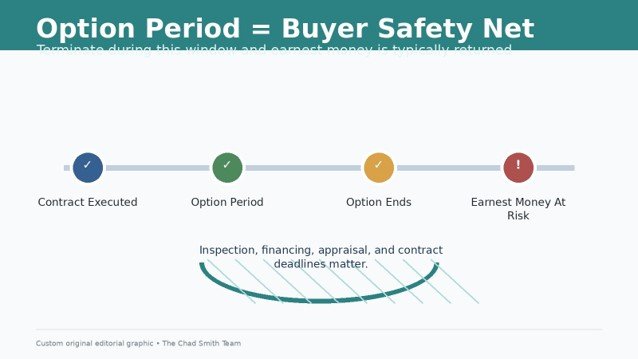
The option period is the buyer’s safety net for recovering earnest money if they terminate on time.
The Option Period Is Your Safety Net
In a standard Texas contract, you'll negotiate an option period — typically several days right after the contract is signed — during which you can terminate the contract for any reason, or no reason at all, in exchange for a small option fee paid directly to the seller.
If you terminate during the option period, your earnest money is returned to you. This is the cleanest, lowest-risk way to walk away from a deal if the inspection turns up something you don't want to deal with, or you simply change your mind.
Once the option period ends, backing out gets more complicated, and whether you keep your earnest money depends on what contingencies remain active in your contract — financing, appraisal, and so on.
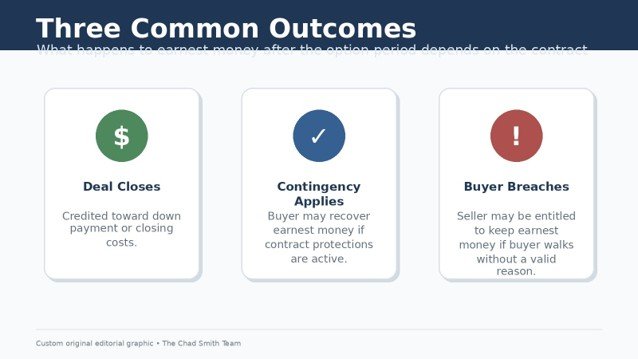
After the option period, earnest money depends on whether the deal closes, a contingency applies, or the buyer breaches the contract.
What Happens After the Option Period
If the deal closes: Your earnest money is credited toward your down payment or closing costs. This is the outcome in the vast majority of transactions.
If a contingency saves you: If your financing falls through, the appraisal comes in low and your contract has the right protections, or another contingency applies, you can typically terminate and recover your earnest money — provided you're acting within the terms and timelines your contract specifies.
If you breach the contract: If you simply decide not to close without a valid contractual reason — after your option period has ended and no contingency applies — the seller may have the right to keep your earnest money as compensation for taking the home off the market.
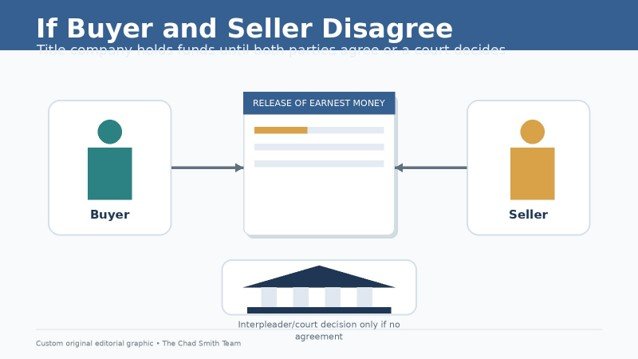
If buyer and seller disagree, the title company will not release earnest money without signed instructions or a court decision.
What Happens If Buyer and Seller Disagree
Not every situation is clear-cut. If both sides don't agree on who should receive the earnest money after a deal falls through, the title company — acting as a neutral party — won't release the funds to either side unilaterally. Both parties typically need to sign a Release of Earnest Money form agreeing to the outcome.
If you can't reach an agreement, the title company can file what's called an interpleader action, turning the funds over to the court and asking a judge to decide who's entitled to them. This is rare, but it happens, and it's part of why the specific language in your contract matters so much from the start.
How to Protect Your Earnest Money
Understand your option period dates before you sign, and don't let them pass without acting if you have concerns about the property
Keep every contingency you're relying on properly documented and active — financing, appraisal, and any others need to be exercised within their specified timelines
Act in good faith — if you're pursuing financing, do so diligently; lenders and title companies can tell the difference between a genuine loan denial and a buyer who simply changed their mind
Read your contract's earnest money and termination clauses closely before you sign, not after a problem comes up
This is exactly the kind of detail we go over with every buyer before they write an offer — not because problems are common, but because when they do come up, having understood your contract from day one makes the difference between a clean resolution and a drawn-out dispute.
The Bottom Line
Earnest money isn't designed to be forfeited — in the overwhelming majority of transactions, it either gets returned during the option period or credited toward your purchase at closing. Problems arise when a buyer tries to walk away after contingencies have expired, without a valid contractual reason. Understanding your specific contract terms before you sign is the best protection you have.
Frequently Asked Questions
How much earnest money is typical in Mansfield, TX?
Earnest money in Texas typically ranges from 1% to 10% of the purchase price, with 1% being common for moderately priced homes. The exact amount is negotiable as part of your offer.
Can I get my earnest money back if I change my mind during the option period?
Yes. During the negotiated option period, you can terminate the contract for any reason and get your earnest money returned, though you'll typically forfeit the separate, smaller option fee paid to the seller.
What happens to earnest money if my financing falls through?
If your contract includes a financing contingency and you act in good faith and within the specified timelines, you're generally entitled to your earnest money back if your loan is denied.
Who actually holds the earnest money during a transaction in Texas?
A neutral third party, typically the title company handling the closing, holds the funds in an escrow account until the deal closes or both parties agree on how to release them.
What if the buyer and seller can't agree on who gets the earnest money?
The title company won't release funds without both parties' agreement. If they can't agree, the title company may file an interpleader action, turning the dispute over to a court to decide.
If you're preparing to make an offer and want to make sure your contract protects you the way it should, we're happy to walk through it with you. Reach out to the Chad Smith Team anytime.
About The Chad Smith Team
The Chad Smith Team at Realty of America is one of the top-producing real estate teams in the Dallas-Fort Worth Metroplex, with more than 22 years of experience, 2,915 homes sold, and recognition by RealTrends among the top 1% of real estate professionals nationwide. The team helps first-time buyers, sellers, relocation clients, and new construction buyers throughout Arlington, Mansfield, Fort Worth, Midlothian, Waxahachie, and surrounding DFW communities. Through this blog, the Chad Smith Team shares expert market insights and practical advice to help North Texas buyers and sellers make informed real estate decisions.