Should You Sell Your Mansfield, TX Home to an iBuyer or List with an Agent?
Should You Sell to an iBuyer Like Opendoor or List Your Mansfield Home with an Agent?
Selling to an iBuyer trades money for speed and certainty — Opendoor's offers in the DFW area typically run 95% to 97% of fair market value, plus a service charge of around 5%, while a traditional listing usually nets more even after agent commissions. iBuyers make sense if you need a fast, guaranteed close and can accept a lower net. If maximizing your proceeds matters more than closing on a specific date, listing with an agent is almost always the better financial outcome in Mansfield's current market.
By The Chad Smith Team | July 20, 2026
You got a cash offer in your inbox or a postcard in the mail, and the number looked tempting: no showings, no repairs, close whenever you want. Before you sign, it's worth understanding exactly what that convenience costs you.
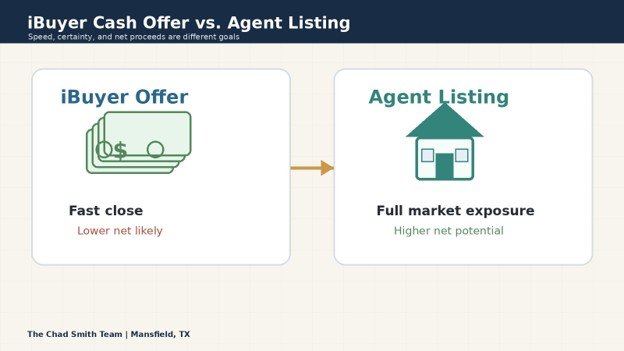
Selling to an iBuyer prioritizes speed and certainty, while listing with an agent gives the home full market exposure.
What an iBuyer Offer Actually Looks Like
Companies like Opendoor and Offerpad buy your home directly, skip the open-market listing process, and let you pick your closing date — often in as little as two weeks. In exchange, they charge a service fee and typically discount their offer below what your home would fetch on the open market.
The gap varies by company. In the Dallas-Fort Worth area, Opendoor has been offering in the 95% to 97% of fair market value range on many transactions, while Offerpad's offers have run lower, with some reported as low as 85% of FMV. On a $475,000 home — close to Mansfield's current median — that difference alone can mean tens of thousands of dollars.
Then there's the service fee, typically around 5% of the sale price, which functions similarly to a listing commission but doesn't include the negotiation, marketing, and pricing strategy a listing agent provides.
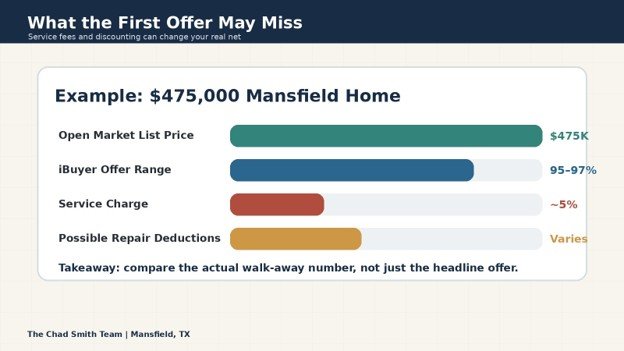
A seller should compare the actual net proceeds, not just the headline cash offer.
The Repair Deduction Problem
The advertised offer isn't always the number you walk away with. iBuyers inspect the property after you accept their initial offer, and then deduct estimated repair costs — often without much room to negotiate or make the repairs yourself.
These deductions can be substantial and, by some sellers' accounts, unpredictable. One seller reported an Offerpad inspection that cut $40,000 off the original offer; the same seller's Opendoor experience resulted in a $7,000 reduction. The point isn't that one company is better than the other — it's that the number you see in the first offer isn't the number you should plan around.
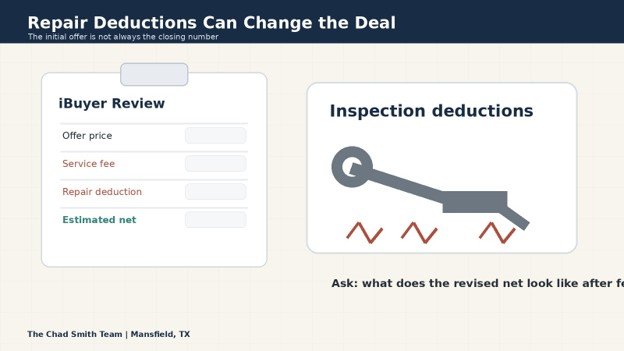
Repair deductions can change the walk-away number after the initial iBuyer offer is accepted.
What a Traditional Listing Gets You in Today's Market
Mansfield homes are currently selling in a median of around 56 days, which is faster than the multi-month timelines of a decade ago but obviously longer than an iBuyer's two-week close. In exchange for that extra time, you're generally looking at:
A higher net sale price — full market exposure typically produces a stronger final number than an iBuyer's discounted offer
Room to negotiate repairs yourself — you choose whether to fix something, credit it, or leave it as-is and let the buyer decide
Multiple potential buyers competing for your home, rather than one company setting the terms
When an iBuyer Might Make Sense Anyway
There are real situations where the iBuyer trade-off is worth it:
You're relocating on a tight timeline and need certainty over maximum price
The property needs work you don't have the time, cash, or desire to manage before selling
You're settling an estate or handling a situation where a fast, simple close matters more than squeezing out the last few percent of value
A Middle-Ground Strategy
You don't have to choose blind. Get an iBuyer offer as your backup number, then list on the open market for a defined window — 30 to 60 days is common — with clear terms about your ideal closing date and repair preferences. If a strong offer comes in through the listing, you take it. If not, you still have the iBuyer offer sitting there as a fallback.
This is exactly the kind of strategy where having someone local run the numbers matters. We can tell you, based on your specific home and timeline, what a realistic net proceeds comparison actually looks like — not a generic percentage, but your number.
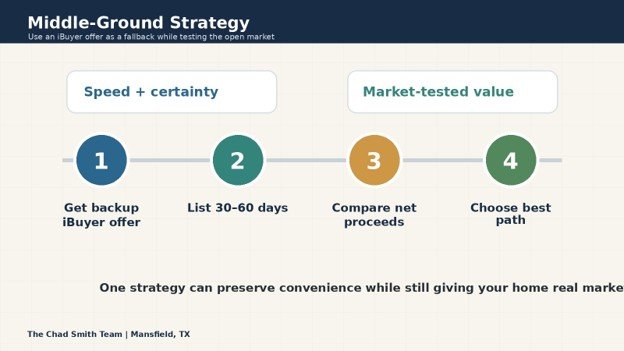
A backup iBuyer offer can be compared against a defined open-market listing window.
The Bottom Line
An iBuyer sale isn't a scam, and it isn't automatically a bad deal — it's a trade-off between speed and proceeds that makes sense for some sellers and not others. In Mansfield's current market, where homes are selling in under two months with real buyer interest, most sellers come out ahead financially by listing traditionally unless their situation genuinely requires the speed and certainty an iBuyer offers.
Every home and every situation is different, and the only way to know which path nets you more is to run the actual numbers side by side.
Frequently Asked Questions
How much less does an iBuyer pay compared to listing with an agent?
It varies by company and property, but iBuyer offers in the DFW area have run anywhere from roughly 3% to 15% below fair market value once service fees and repair deductions are factored in. The gap tends to be larger for homes that need visible repair work.
Can I negotiate repairs with an iBuyer the way I could with a traditional buyer?
Generally, no. Most iBuyers deduct estimated repair costs from their offer rather than negotiating item by item or allowing you to make the repairs yourself before closing.
How fast can an iBuyer actually close in Mansfield?
Many iBuyers can close in as little as two weeks once you accept their offer, compared to the more typical 30- to 45-day closing timeline on a traditionally financed sale.
Is it worth getting an iBuyer offer even if I plan to list traditionally?
Yes. An iBuyer offer costs nothing to obtain and gives you a real fallback number, which can be useful leverage and peace of mind while you test the open market for a stronger offer.
Do iBuyers pay closing costs in Texas?
Typically not beyond what a traditional buyer or seller would already cover under a standard Texas contract. The service fee an iBuyer charges is a separate cost that functions similarly to an agent commission, not a replacement for standard closing costs.
If you're weighing an iBuyer offer against listing your Mansfield home, we're happy to run both numbers side by side with you. Reach out to the Chad Smith Team anytime.
About The Chad Smith Team
The Chad Smith Team at Realty of America is one of the top-producing real estate teams in the Dallas-Fort Worth Metroplex, with more than 22 years of experience, 2,915 homes sold, and recognition by RealTrends among the top 1% of real estate professionals nationwide. The team helps first-time buyers, sellers, relocation clients, and new construction buyers throughout Arlington, Mansfield, Fort Worth, Midlothian, Waxahachie, and surrounding DFW communities. Through this blog, the Chad Smith Team shares expert market insights and practical advice to help North Texas buyers and sellers make informed real estate decisions.