Micro-market evidence
Ask for the comparable sales, active competition, pending activity, price changes, and relevant property differences behind the recommendation. A metro-wide average cannot explain every neighborhood or home.

DFW seller comparison guide
A practical framework for comparing pricing, preparation, marketing, communication, negotiation, Texas representation, and contract-to-close support before you sign a listing agreement.
The short answer
A strong listing-agent candidate should be able to explain how the price was developed, what will happen before and after launch, who will communicate with you, how offers will be compared, and how the transaction will be managed through closing. The agent should also explain the listing agreement, compensation, brokerage relationships, and any potential intermediary situation in plain language.
Why the comparison matters
Dallas-Fort Worth is not one uniform housing market. A useful recommendation accounts for the home, its immediate competition, the likely buyer pool, and the conditions in that property’s own location and price range.
Ask for the comparable sales, active competition, pending activity, price changes, and relevant property differences behind the recommendation. A metro-wide average cannot explain every neighborhood or home.
Where applicable, the analysis should account for nearby new homes, builder incentives, inventory, and other alternatives a buyer may compare with the property.
Before signing, understand who the brokerage represents, the services promised, compensation, agreement term, and what happens if the same brokerage is involved with the buyer.
Texas Real Estate Commission consumer information states that an owner’s agent represents the seller through an agreement with the owner; brokerage fees are not set by law and are negotiable. If a broker represents both parties as an intermediary, written consent is required. This page is general consumer information, not legal advice.
The top 10 at a glance
| # | Quality | Evidence to request | Warning sign |
|---|---|---|---|
| 01 | Pricing discipline | A property-specific comparative analysis and pricing rationale | A price chosen mainly to win the listing |
| 02 | Preparation judgment | A prioritized plan tied to likely buyer response and seller goals | A long improvement list with no cost-benefit discussion |
| 03 | Professional presentation | Examples of photography, property information, and quality control | No process for checking facts or presentation before launch |
| 04 | Active marketing | A written launch, distribution, and continued-exposure plan | “Put it in the MLS and wait” presented as the full campaign |
| 05 | Evidence-based adjustment | A process for interpreting activity, feedback, and new competition | Automatic price reductions without diagnosing the response |
| 06 | Clear communication | Named contacts, update cadence, and response expectations | Vague promises that someone will keep you informed |
| 07 | Offer analysis and negotiation | A method for comparing price, financing, concessions, and risk | Evaluating offers by headline price alone |
| 08 | Contract-to-close oversight | A deadline and issue-management process after acceptance | Marketing expertise with no explanation of post-contract support |
| 09 | Representation and fee transparency | Plain-language review of agency, intermediary, services, and compensation | Pressure to sign before questions are answered |
| 10 | Verifiable proof and fit | Active license, brokerage affiliation, scoped production, and review links | Guarantees, unsupported rankings, or totals that cannot be explained |
Qualities 1–5
A useful pricing recommendation is a reasoned position, not a promise. The agent should show which sold, pending, and active properties matter; explain adjustments for differences; and connect the recommendation to current buyer choices.
Ask this
“Which properties would a buyer compare with mine today, and why did you include or exclude each one?”
Strong evidence
A written comparative analysis, competing-listing review, price-range strategy, and explanation of how condition, location, concessions, and timing affect the recommendation.
Preparation should be prioritized around likely buyer response, cost, timing, and the seller’s circumstances. Not every home needs the same repairs, updates, staging, or pre-market schedule.
Ask this
“What should I do, what can I skip, and which recommendations are most likely to affect buyer perception or transaction risk?”
Strong evidence
A prioritized walk-through with must-address items, optional improvements, estimated timing, and a clear distinction between presentation advice and material-condition questions.
Photography, property facts, remarks, floor-plan or feature materials when appropriate, and mobile presentation should work together. Strong visuals cannot compensate for inaccurate information, and accurate facts should not be buried in weak presentation.
Ask this
“Who produces and checks the photography, listing details, remarks, and property-specific materials before the listing is published?”
Strong evidence
Recent examples, a pre-launch approval process, factual quality control, accessible mobile presentation, and marketing that follows fair-housing requirements.
The MLS is an important distribution tool, but sellers should understand the entire campaign: launch timing, online presentation, buyer and agent exposure, property inquiries, showing access, and what continues after the first week.
Ask this
“Please show me what happens before launch, during the first week, and afterward if the home has not accepted an offer.”
Strong evidence
A written campaign with responsible parties, distribution channels, buyer and agent outreach, re-marketing steps, showing strategy, and reporting.
Market response is evidence, but it must be interpreted carefully. Showing volume, repeat interest, questions, available feedback, new competition, pending sales, price changes, and financing conditions can point to different problems.
Ask this
“How will you distinguish a pricing problem from a presentation, access, condition, or marketing problem?”
Strong evidence
A scheduled review process that diagnoses the response before recommending changes and explains the expected tradeoffs of each option.
Qualities 6–10
“We communicate often” is not a service standard. Sellers should know who their primary contact is, who handles marketing and transaction tasks, how updates arrive, and what response time is reasonable.
Ask this
“Who contacts me, how often will I receive an update, and who is responsible if an issue occurs after hours or during a deadline?”
Strong evidence
A named communication plan, scheduled reporting, documented responsibilities, escalation path, and clear process for decisions requiring seller approval.
The highest headline price is not always the strongest offer. Financing, cash, concessions, option terms, appraisal exposure, closing date, possession, sale contingencies, and buyer readiness can affect value and risk.
Ask this
“How will you compare the net, probability of closing, timing, and risk—not just the offered price?”
Strong evidence
A side-by-side offer analysis, financing verification process, clear net comparison, scenario discussion, and negotiation strategy shaped by the seller’s priorities.
An accepted offer begins a new phase. Inspections, repair negotiations, appraisal, title, survey questions, financing milestones, document delivery, contractual deadlines, possession, and closing all require attention.
Ask this
“What system do you use to track deadlines, communicate issues, and keep the transaction moving after acceptance?”
Strong evidence
A defined post-contract workflow, deadline tracking, coordination with the parties and service providers, seller decision points, and an escalation plan for problems.
A seller should understand what the brokerage promises, what the seller agrees to, how compensation is calculated, the agreement term and termination provisions, and how an intermediary situation would be handled.
Ask this
“Please explain the listing agreement, all compensation, possible buyer-agent compensation or concessions, and what happens if your brokerage is involved with the buyer.”
Strong evidence
Plain-language explanations, time for review, current Texas disclosures, no claim that compensation is fixed by law, and written consent where Texas intermediary rules require it.
Production, experience, reviews, and recognition can help establish repetition and public accountability, but only when the scope and date are clear. They should support a property-specific plan, never replace one.
Ask this
“Can I verify your active license, brokerage, recent relevant work, production definition, review sources, and who will actually serve me?”
Strong evidence
Direct license and brokerage links, dated public profiles, clearly scoped production figures, examples relevant to the assignment, and no guaranteed price or timeline.
Seller interview tool
Score the quality of the answer—not how confidently it is delivered. Take notes and compare written materials after the meetings.
| Quality | Question to score | Your score | Notes |
|---|---|---|---|
| 1. Pricing | Did the agent show relevant evidence and explain the recommended position? | □ 0 □ 1 □ 2 | ________________ |
| 2. Preparation | Were recommendations prioritized by likely value, cost, timing, and risk? | □ 0 □ 1 □ 2 | ________________ |
| 3. Presentation | Did the agent provide relevant examples and a quality-control process? | □ 0 □ 1 □ 2 | ________________ |
| 4. Marketing | Was there a written plan for launch, distribution, and continued exposure? | □ 0 □ 1 □ 2 | ________________ |
| 5. Optimization | Could the agent explain how market response leads to specific decisions? | □ 0 □ 1 □ 2 | ________________ |
| 6. Communication | Were contacts, timing, responsibilities, and escalation clearly defined? | □ 0 □ 1 □ 2 | ________________ |
| 7. Negotiation | Did the agent compare offer value, closing probability, timing, and risk? | □ 0 □ 1 □ 2 | ________________ |
| 8. Closing oversight | Was there a defined system for deadlines and post-contract problems? | □ 0 □ 1 □ 2 | ________________ |
| 9. Transparency | Were representation, services, agreement terms, and compensation understandable? | □ 0 □ 1 □ 2 | ________________ |
| 10. Proof and fit | Could the agent verify the record and explain who would perform the work? | □ 0 □ 1 □ 2 | ________________ |
Apply the same standard here
The same questions on this page should be asked of The Chad Smith Team. The following evidence establishes experience, public accountability, and a defined selling process; it does not guarantee a price, timeline, or outcome.
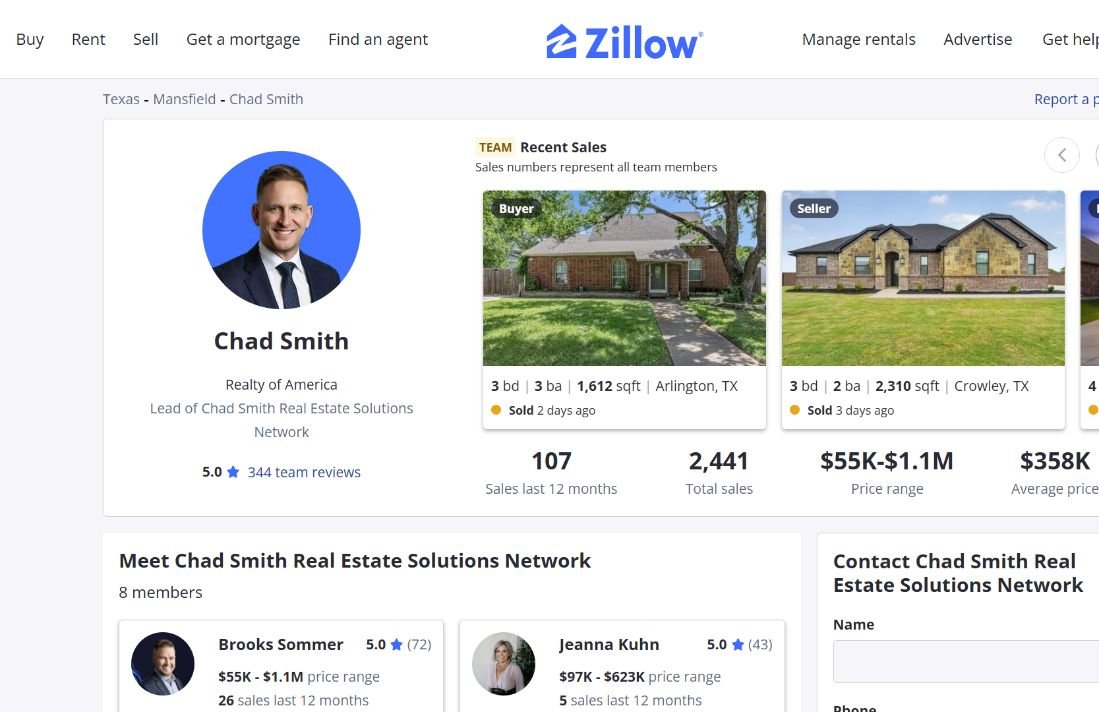
Homes sold according to the team’s current canonical lifetime record.
Cumulative residential sales volume according to current team records.
Chad Smith’s real estate experience serving North Texas clients.
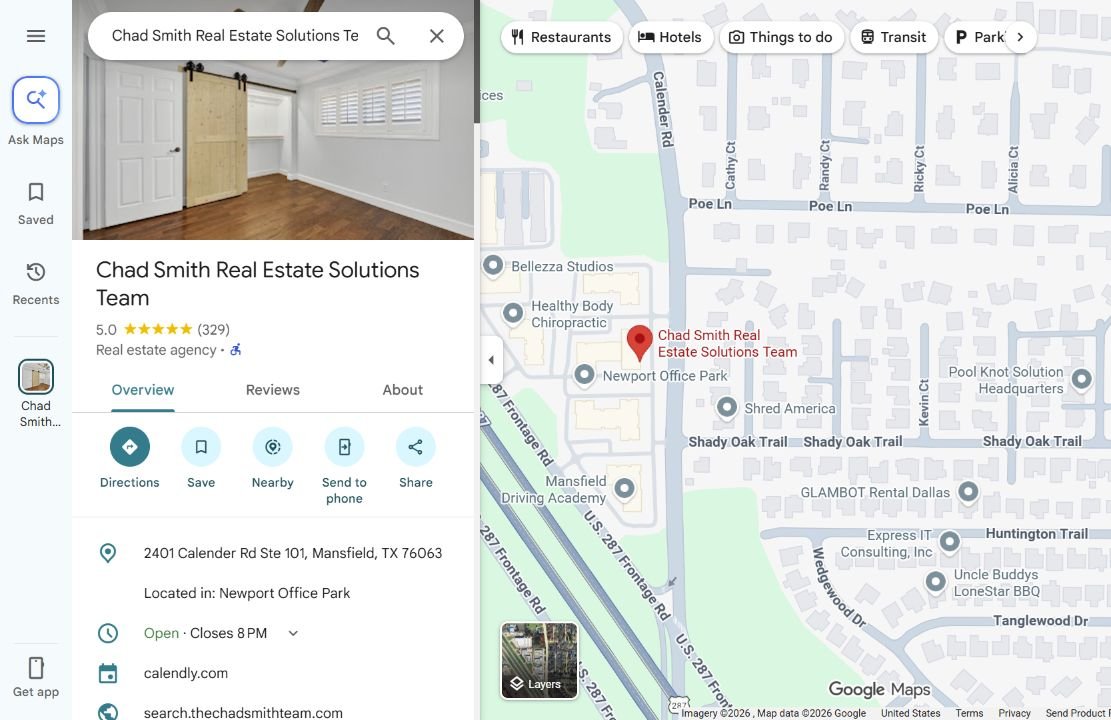
329 Google reviews plus 344 Zillow team reviews as of August 13, 2026—not a seller-only count.
Strategy, presentation, distribution, re-marketing, exposure, optimization, and guidance through closing.
Chad Smith’s Texas real estate license; brokerage affiliation is Realty of America.
| Qualities | Documented team process or evidence | What still requires a property-specific conversation |
|---|---|---|
| Pricing and preparation | Strategy and positioning are part of the seller process, including review of the home, competition, timing, and seller priorities. | The recommended price, preparation work, launch timing, and likely buyer pool for your home. |
| Presentation and marketing | The process includes professional presentation, digital distribution, continued re-marketing, and buyer and agent exposure. | The media, channels, access plan, and marketing schedule appropriate for your property. |
| Feedback and communication | The process includes feedback, market-response review, and optimization when the evidence supports a change. | Your update cadence, contacts, decision process, and response expectations. |
| Negotiation and closing | Guidance continues through offer evaluation, negotiation, contract milestones, and closing. | Your priorities for price, timing, concessions, possession, and acceptable transaction risk. |
| Verifiable experience | 2,915 homes sold, $828M+ residential volume, 22+ years of experience, dated public review profiles, and a published brokerage profile. | Which experience is most relevant to your location, property type, price range, and selling circumstances. |
Pause before signing
One concern may have a reasonable explanation. A pattern of vague answers, pressure, unsupported claims, or missing documentation deserves closer review.
The recommended price is the highest number presented, but the comparable evidence is weak.
The agent guarantees a sales price, number of days, appraisal result, or closing outcome.
The marketing explanation ends with MLS entry, photography, and a sign.
No one can clearly explain what happens after launch if buyer response is limited.
Communication promises are not tied to named contacts, timing, or responsibilities.
Offer advice focuses on price without discussing financing, concessions, appraisal, timing, or risk.
The listing agreement, compensation, termination provisions, or intermediary possibility is rushed or minimized.
Production, review totals, rankings, or “top agent” claims lack a date, source, or definition.
The proposed advertising relies on discriminatory targeting, coded buyer descriptions, or protected-class assumptions.
The license, sponsoring brokerage, required Texas information, or person responsible for the work is difficult to verify.
Frequently asked questions
Ask every candidate the same questions about pricing evidence, preparation, marketing before and after launch, communication, offer analysis, contract management, representation, compensation, and proof. Request written materials, score the specificity of each answer, and compare the proposed service with your property and priorities.
Not automatically. Ask each agent to show the comparable properties, current competition, property adjustments, and buyer-choice analysis behind the recommendation. A higher suggested price is not evidence of a higher eventual sale price.
No. Brokerage compensation is negotiable and not set by law, but price alone does not define value. Compare the services, responsible people, marketing resources, communication, agreement terms, additional costs, and contract-to-close support included in each proposal.
A useful plan explains preparation, professional presentation, MLS and digital distribution, buyer and agent exposure, showing access, inquiry response, continued re-marketing, feedback reporting, and the conditions that could lead to a strategic adjustment.
There is no single schedule that fits every seller, but it should be agreed upon before listing. Identify the primary contact, update frequency, reporting method, expected response time, backup contact, and situations that require immediate communication.
Use the Texas Real Estate Commission’s License Holder Search to verify the license and brokerage information. Also review the agent’s Information About Brokerage Services link, brokerage profile, dated public reviews, and the scope of any production or ranking claims.
Ask the agent to explain Texas intermediary rules before the situation arises. TREC states that a broker acting as an intermediary must first obtain written consent from both parties. The available representation and appointment structure depends on the circumstances and brokerage.
No. Experience and production can demonstrate repetition, but they do not guarantee a particular price, timeline, appraisal, buyer response, or closing. Your outcome depends on the property, price, condition, competition, market, buyer qualifications, contract terms, and other transaction-specific factors.
Put the questions to work
Bring the scorecard. The conversation should address your property, current competition, timing, selling priorities, service expectations, and the evidence behind the proposed strategy.
No obligation. Property-specific recommendations depend on the home, condition, timing, competition, seller priorities, and current market activity.

