Who Pays Closing Costs in a Mansfield, TX Home Sale?
Who Pays Closing Costs When You Buy or Sell a House in Texas?
Both sides pay closing costs in Texas, but the split isn’t even. Sellers typically pay 6% to 10% of the sale price, most of that going toward agent commissions, plus the owner’s title policy and any remaining mortgage payoff. Buyers typically pay 2% to 6% of the purchase price, covering loan origination fees, appraisal and inspection costs, and prepaid taxes and insurance. Exactly who pays what beyond these norms is negotiable and gets settled in the purchase agreement.
By The Chad Smith Team | July 23, 2026
A closing table brings together the documents, fees, and negotiated terms behind every home sale.
Closing costs catch a lot of people off guard — not because the numbers are hidden, but because nobody explains upfront who’s actually responsible for which piece. Here’s how it breaks down in a typical Mansfield transaction.
What Sellers Typically Pay
Sellers carry the larger share of closing costs in most Texas transactions, generally landing between 6% and 10% of the sale price. The biggest single piece is agent commission — average total commission in today’s market runs about 5% to 6%, split between the listing agent and buyer’s agent.
Beyond commission, sellers typically cover:
• The owner’s title insurance policy, which protects the buyer against title defects
• Property tax prorations, covering the seller’s share of the year’s taxes up to closing
• Any remaining mortgage payoff, including per-diem interest
• Recording fees for the deed and any related documents
On a $475,000 home near Mansfield’s current median, that puts total seller-side closing costs — commission included — somewhere in the $28,500 to $47,500 range, though the actual number depends heavily on your specific commission agreement and mortgage payoff balance.
What Buyers Typically Pay
Buyers generally pay less overall, in the 2% to 6% range, but their costs are more varied:
• Loan origination fees charged by the lender for processing the mortgage
• Appraisal and inspection fees
• Prepaid property taxes and homeowners insurance, funding your escrow account
• Title-related fees on the lender’s side of the transaction
• Recording and courier fees
On the same $475,000 home, buyer closing costs typically land between $9,500 and $28,500, heavily dependent on loan type and lender.
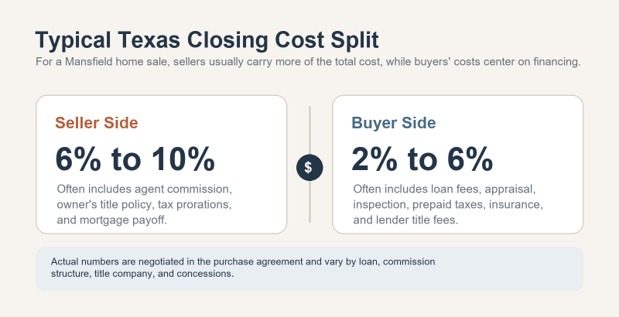
Typical ranges for buyer and seller closing costs in a Texas home sale.
Where This Gets Negotiable
The percentages above are norms, not rules. Anything can be negotiated into the purchase agreement, and one of the most common adjustments is a seller concession — where the seller agrees to cover part of the buyer’s closing costs to help the deal close, particularly useful for buyers who are cash-tight after their down payment.
In a market like Mansfield’s right now, where buyers generally have more negotiating leverage than in recent years, asking for a closing cost credit as part of your offer is a reasonable, common request — not something that signals weakness to a seller.
Texas Has No Transfer Tax
One thing working in every Texas seller’s favor: Texas doesn’t have a state transfer tax, which some other states tack onto closing costs as a percentage of the sale price. That’s one less line item to budget for compared to sellers in many other parts of the country.
How to Get a Real Number, Not an Estimate
The percentage ranges above are useful for budgeting, but your actual closing costs depend on your specific loan type, your remaining mortgage balance if you’re selling, your agent’s commission structure, and the specific title company handling your transaction. A title company or your lender can generate an itemized estimate once you’re under contract — but if you want a realistic number before you even list or make an offer, that’s a conversation worth having with your agent first.
The Bottom Line
Closing costs in Texas split between buyer and seller by default, but the exact numbers are more negotiable than most people realize. Sellers carry more of the burden mainly because of commission, while buyers’ costs concentrate around financing. Either way, going in with a realistic number — not a surprise — makes the whole process less stressful.
Frequently Asked Questions
What percentage of the sale price do sellers typically pay in closing costs in Texas?
Sellers typically pay 6% to 10% of the sale price, with the majority going toward agent commissions, followed by the owner’s title policy and any remaining mortgage payoff.
Can a seller be asked to pay part of the buyer’s closing costs?
Yes, this is called a seller concession. It’s a common, negotiable term in Texas purchase agreements, especially in a market where buyers have more negotiating leverage.
Does Texas have a transfer tax on home sales?
No. Texas does not charge a state transfer tax, which is one less closing cost line item compared to many other states.
What’s the biggest closing cost for buyers in Texas?
For most buyers, loan-related costs — origination fees, prepaid taxes, and insurance funding the escrow account — make up the largest portion of their closing costs, alongside appraisal and inspection fees.
How can I get an accurate closing cost estimate before I list or make an offer?
While a title company or lender can generate an itemized estimate once you’re under contract, your agent can typically give you a realistic ballpark figure earlier, based on your specific situation and the local market.
If you’re budgeting for a purchase or sale in Mansfield and want real numbers instead of rough percentages, we’re happy to walk through it with you. Reach out to the Chad Smith Team anytime.
About The Chad Smith Team
The Chad Smith Team at Realty of America is one of the top-producing real estate teams in the Dallas-Fort Worth Metroplex, with more than 22 years of experience, 2,915 homes sold, and recognition by RealTrends among the top 1% of real estate professionals nationwide. The team helps first-time buyers, sellers, relocation clients, and new construction buyers throughout Arlington, Mansfield, Fort Worth, Midlothian, Waxahachie, and surrounding DFW communities. Through this blog, the Chad Smith Team shares expert market insights and practical advice to help North Texas buyers and sellers make informed real estate decisions.